For people in communities that have long endured wildfires, managing wildfire risk may already be familiar. But as climate change contributes to drier, hotter conditions, wildfire risk is increasing and expanding into areas that may be unprepared and unprotected. These places will either face increasing potential damage or learn to adapt to new climate risks.
Climate adaptation—the process of strengthening systems against climate risks—can help manage wildfire risk by lowering vulnerability, limiting exposure, and decreasing financial responsibility for losses. This protects the people, natural environment, and local infrastructure in a place from harm.
Climate adaptation strategies for wildfire are available to nearly everyone, spanning a wide spectrum of complexity and cost. Some actions are essentially free and straightforward, such as creating an action plan and a neighborhood call sheet, while others require significant investment or major changes, like building differently or permanently relocating.
These strategies can be taken at the individual or household level, while others occur at the scale of a neighborhood, a company, or a local government, across both the public and private sectors. Larger-scale actions typically require coordination among communities, businesses, and governments. Even the simplest climate adaptation steps can meaningfully improve preparedness.
Wildfire prevention: reducing the hazard
Wildfire risk is a measure of the likelihood that a wildfire will ignite, spread, and cause harm to people, ecosystems, or structures. In the case of wildfires, people can sometimes reduce the climate hazard by preventing ignition, controlling the conditions that enable its growth, and stopping its spread. It is distinct from other types of climate risks, such as heat or storms, which occur entirely outside human control.
Climate data can show the impact of dry, hot conditions on the number of wildfire-danger days, a metric based on the Fire Weather Index that indicates how likely wildfire spread is, given the presence of burnable fuel and an ignition source, under conditions of temperature and dryness. This comparison map shows the change in wildfire danger days globally for warming levels between 1.5°C (approximately current levels of warming) and 3°C:
The start, spread, and severity of wildfires all depend largely on human behavior. For example, individuals can remove dry brush and other flammable material from around their homes. Governments and cities can fund and coordinate firefighting forces to conduct prescribed burns, contain wildfires quickly, and reduce their spread. Still, even with these essential preventive and suppression measures, many places will continue to face frequent wildfires and will need climate adaptation approaches to manage risk.
Climate adaptation approaches to manage wildfire risk
Climate adaptation offers a framework for managing the growing threat of wildfire by reducing vulnerability, limiting exposure, transferring risk, and determining what level of risk communities can tolerate. Because human activity plays a significant role in shaping wildfire behavior, these approaches can meaningfully influence the extent of harm a fire causes if ignited.
Reducing vulnerability to wildfire risk
Reducing vulnerability to wildfire risk involves making people, places, and ecosystems better able to withstand fire when it occurs—not only by making homes, infrastructure, and landscapes less flammable but also by improving how communities prepare and respond and supporting recovery for both people and nature. This includes strategies that strengthen both built and natural environments, as well as those that protect human health and safety.
For example, builders, architects, and homeowners can use engineered fire-resistant materials and construction practices to harden homes and infrastructure against wildfires. Metal or tile roofs, sealed eaves, noncombustible siding, and removing dry vegetation around buildings all reduce vulnerability by making it harder for fire to ignite and spread.
One important benefit of reducing vulnerability is that it often benefits nearby communities as well. If one person’s home, yard, or business is less likely to catch fire, the chance that flames will spread to their neighboring properties or nearby areas is lower, and the same is true in reverse.
People themselves can also become less vulnerable by protecting their health and physical safety. Evacuation plans, clean indoor air from proper filtration, safe indoor temperatures through air conditioning, and strong social networks—where people check in on one another during fire season—all help protect human health and lives. Adjusting behaviors, such as practicing evacuation routes, limiting strenuous activity when there is heavy smoke in the air, and using masks or air filters when air quality is poor, can also reduce an individual’s vulnerability to wildfires.
Reducing exposure to wildfire risk
Reducing exposure to wildfire risk means spending less time in places and situations where fires can cause harm.
When homes, infrastructure, and key services like power, water, roads, and communications are located farther from likely fire paths or are removed in response to high wildfire risk, they are less exposed. One way to reduce exposure is to avoid constructing or expanding infrastructure in high-risk wildfire areas, such as steep, heavily forested slopes or the borders between urban and natural environments, where structures are close to flammable vegetation. Governments can design zoning regulations and relocation programs that help move physical assets out of the most dangerous places.
People can reduce their personal exposure by avoiding living, working, or spending time in high-risk wildfire areas, especially on days with extreme fire weather. They can also choose travel routes that avoid active fires and evacuation zones. Businesses can adopt policies that prevent workers from operating in areas with high wildfire exposure or when air quality is compromised by wildfire smoke.
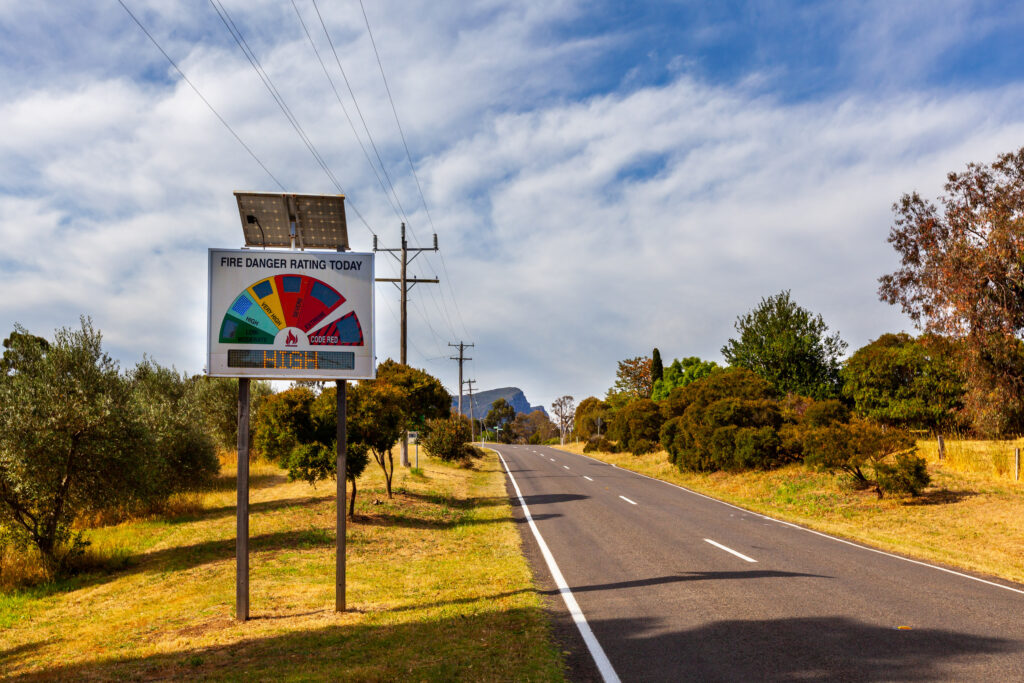
When a wildfire is likely to start or has already begun, leaving the area early is the only way for humans to reduce their exposure. Governments can implement early-warning systems to alert people to prepare to move or evacuate when wildfire conditions worsen, giving them time to prepare to move or evacuate. These alerts work best when individuals and households already have a clear plan for where they will go and how they will get there.
When one person reduces their exposure, they can also reduce exposure for those around them. This creates community-level preparedness for wildfires. Working together, communities can lower their exposure by leaving risky areas early, following evacuation guidance, helping neighbors access information, and supporting emergency responders.
Transfer risk
Risk transfer is a financial strategy that helps reduce personal responsibility for the cost of rebuilding after a wildfire. Unlike strategies that protect human health or harden buildings against fire, risk transfer does not prevent wildfires or the injury, loss of life, or physical damage they can cause. The most common form of risk transfer is property insurance, which may be available to be purchased by individuals, communities, businesses, or governments.
Insurance can help cover the cost of repairing or replacing damaged buildings and infrastructure. For households and individuals, risk transfer can reduce the financial hardship that follows displacement, job loss, or the destruction of personal belongings.
Tolerate risk
Lastly, adapting to wildfire risk can involve learning to tolerate it, living with a high level of wildfire danger, and accepting the consequences of a potential fire. However, an individual’s personal willingness to tolerate risk can increase the danger to those around them. For example, engaging in risky activities—such as building campfires in dry areas during fire season—can ignite a fire that affects an entire community.