Each year, I write to mark Probable Futures’ anniversary. Last year, five years into our mission and work, I focused on our progress—the work our team had accomplished and the impact we were seeing. This year, the context around climate change is shifting in ways that demand reflection, and I want to share how that context is informing our thinking at Probable Futures.
The changed landscape
In the 1980s and 1990s, climate change was a threat, not a reality. Back then, climate leaders hoped to slow or stop warming before our civilization would see material weather-related effects or reach levels of warming that would risk irreversible changes. Those leaders—people like George Woodwell, who created the institution that brought me into this work—achieved admirable results, building the infrastructure, frameworks, and culture that came to define the climate action community.
In 2026, what the climate leaders of the previous era hoped to prevent is now here. Global temperatures from the past three years (2023-2025) averaged more than 1.5°C above the pre-industrial level for the first time. Climate models project that we could reach 2°C of warming as early as the 2030s.
Furthermore, there are now mechanisms in motion that could significantly accelerate and amplify warming beyond human emissions alone. Natural systems like degraded forests and thawing permafrost are now generating planet-warming gases themselves. Additionally, there is early evidence that the earth is absorbing an increasing amount of solar energy, due to less air pollution and possibly even due to a climate-driven reduction in cloud cover.
These feedback loops make our trajectory harder to predict and control, but even in an optimistic scenario—one where we implement current climate policies to the fullest extent, continue deploying clean energy technologies, and avoid triggering feedback mechanisms—we’re still on a trajectory to reach around 2.7°C by 2100.
And yet, public acknowledgement and discussion of this physical reality remain confined to specialists. It has not penetrated mainstream climate messaging, media coverage, or public discourse anywhere near the scale its consequences demand. Some thought leaders even celebrate the current trajectory as a win compared to the much higher warming that once seemed likely.
The climate community is not a monolith, but having tracked climate messaging closely for over a decade, I believe the prevailing narratives are not keeping pace with the science. Terms like “doomerism” have discouraged realism, leading many to mistake clear-eyed risk assessment for defeatism or alarmism. The climate movement needs a shared narrative focused on what outcomes are inevitable, what we can still prevent, and what choices remain available. In other words: What futures can humanity still hope for?
A changing climate will not wait
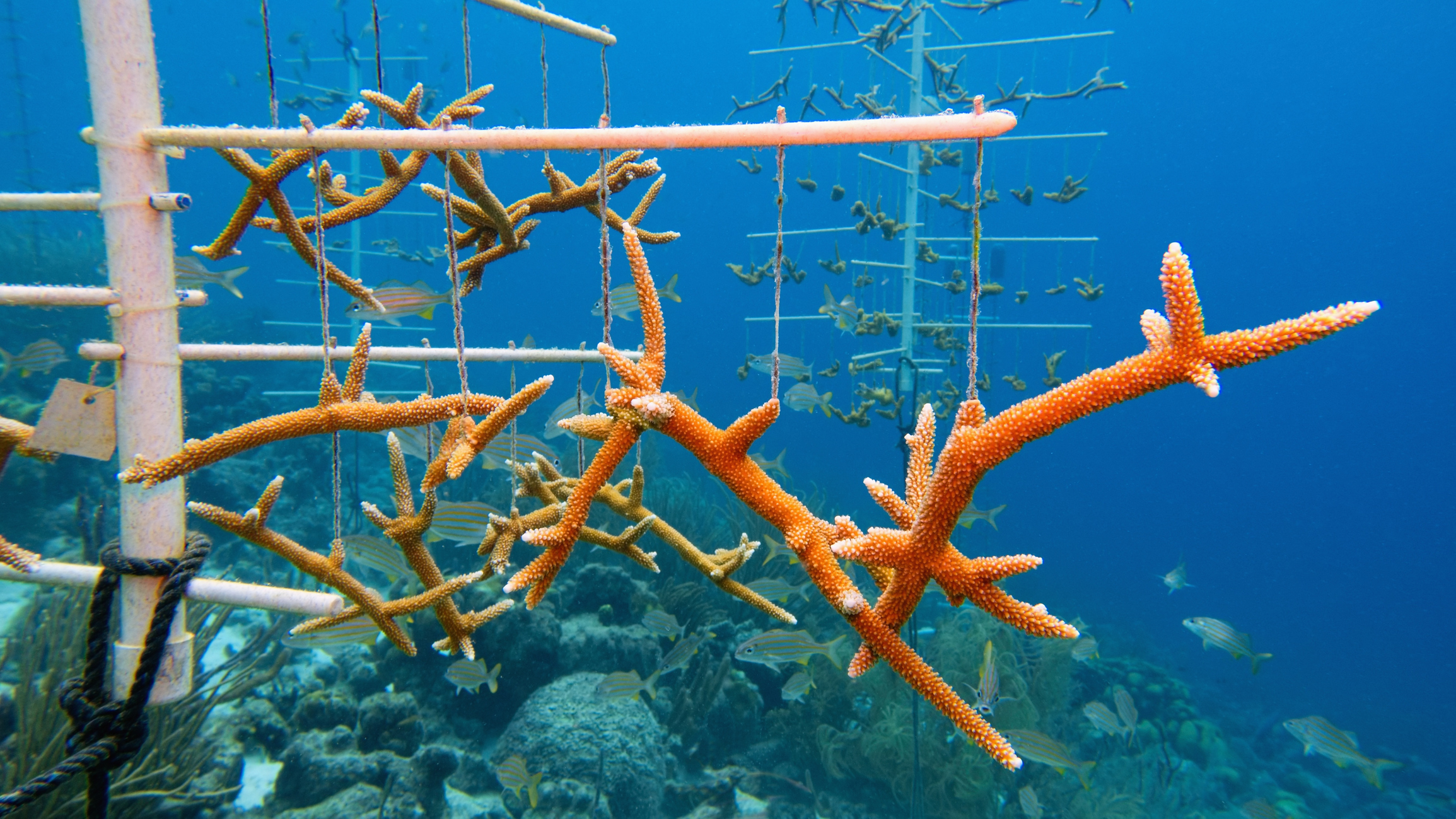
Consider this fact and the myriad questions it presents: 70 to 90% of all warm-water coral reefs will likely die in the next 20 years. Because coral reefs are the wellspring of aquatic life, up to a billion people rely on them for food or their livelihood, through fishing, tourism, or other forms of income. They also help protect coastal communities from storm surge. Who has the responsibility to help communities through that systemic change? What adaptation strategies exist for them? Should scientists document the demise of these ecosystems—and for what purpose? Is it ethical for those who can afford it to rush to see their natural beauty before they become functionally extinct? Should we deploy genetically modified coral? And how should we think about engineering replacement coral for reefs we could have saved?
These questions force us to reckon with a changed landscape of hope—one where it’s no longer realistic to expect that we can save coral reefs entirely, but where we work to mitigate damage, make wise decisions about what to do next, and grieve for the reefs we lose in ways that make us more grateful for what endures, and more determined to protect it.
While there are certainly individual people and organizations wrestling with the questions posed above, mainstream climate messaging still centers on “solving climate change” rather than navigating the climate we’re already living in, and choosing between the probable futures that lie ahead.
Let me be clear: I am encouraged by progress on clean energy, transportation, and carbon removal. I believe that innovation, policy, and cultural forces will probably get us to net-zero emissions eventually, though this task grows more challenging as emissions from natural systems increase. But this progress will take time, and the changing climate will not wait.
This moment poses fundamentally different challenges than leaders faced in the previous era, requiring different strategies. Then, influential people feared that talking about climate adaptation (adjusting to the changes) or intervention (directly modifying the climate system through strategies like CO2 removal or solar radiation management) would give license to avoid preventing the problem through decarbonization. We no longer have that choice.
Climate adaptation is necessary and will happen either intentionally and thoughtfully, or chaotically and responsively. Climate intervention strategies—some more controversial than others—exist, and governments and companies are developing them without international agreements to govern them or market regulations to guide their use. In parallel to these efforts, we need to keep up the momentum on the hard work of transitioning to clean energy systems around the globe. All of this begs the question: Does the climate movement have an orientation that best serves our physical reality in 2026?
Our guiding principles for the work ahead
At Probable Futures, we’re committed to acknowledging difficult truths while maintaining focus on what remains possible—helping people imagine positive futures, build resilience in the face of loss, and identify the tools and strategies to work toward good outcomes even when perfect ones aren't available.
This has been our approach from the beginning. When Spencer Glendon and I started Probable Futures in 2020, we thought it was well past time to have honest conversations about living in a world that has moved from 12,000 years of climate stability into a new paradigm of instability. This is why our team created interactive climate maps depicting climate model predictions all the way up to 3°C of warming. It’s why we developed clear explanations of planetary balance and the Hothouse earth trajectory.
But even as we worked to create clarity about climate risks, we recognized that there was a gap in practical guidance on adaptation. We responded by developing adaptation frameworks and sharing insights, showing communities navigating climatic changes that adaptation is possible and necessary.
Now, as the atmosphere warms further and new risks emerge, we see the next gap: the lack of discussion around crossing major climate thresholds and tipping points. Today’s warming has brought us into the range where several are possible, if not likely—the die-off of warm-water coral reefs, potential collapse of major ice sheets, and potential collapse of ocean circulation systems. These events are within our set of probable futures, yet there’s not enough research on them, there are few resources to help the public understand what they might mean for our daily lives, and practically no policy conversations about what we might do if they’re triggered.
While Probable Futures doesn’t have all of the answers, we are confident that we can contribute meaningfully to building awareness of these growing risks. Exploring these futures will be challenging scientifically, practically, and emotionally—but that doesn't mean we shouldn't do it. Further, frank communication about tipping points could generate more motivation to mitigate emissions, adapt to the risks ahead, and, where necessary and safe, intervene to prevent unmanageable outcomes.
With that in mind, here are the principles that will guide our work in 2026 and beyond:
We will ground ourselves—and others—in scientific rigor.
We’ll continue helping people understand how much our climate has warmed, how much warming is likely ahead, and what different scenarios mean for life on Earth. This means thinking in ranges and considering the full spectrum of probable futures—what’s likely versus uncertain, what’s locked in versus what can be prevented.
Grounded in that scientific clarity, we will learn and share knowledge about climate adaptation.
Climate adaptation is unprecedented and largely undefined. We’re committed to learning from communities, governments, businesses, and individuals who are adapting, and translating those lessons into guidance that helps others. Through this continuous process of learning and sharing, we hope to help people see what’s possible and build their own capacity to navigate change.
We will communicate about both the adaptation we can plan for and the systemic risks that are highly uncertain.
Understanding current risks enables adaptation; understanding tipping points enables informed conversation about what might come next, what we can do to prevent them, and how we can prepare for what we can’t prevent. We’re committed to communicating honestly and with clarity about both—creating tools that help people understand risks that have no precedent and exploring consequences even when climate models can’t give us precise answers.
We will acknowledge loss and continually explore the question of “what can we hope for?”
Some losses can only be grieved, not adapted to. Understanding the full range of probable futures requires building resilience—both to physical climate impacts and to emotional challenges. This means acknowledging loss while working to preserve what remains, and developing the capacity to live through difficulty without surrendering to it. Everything we do at Probable Futures aims to foster this kind of resilience.
All of this work requires people committed to what Thomas Hale calls “long problems”—people who can sustain themselves through work operating on timescales beyond individual lifetimes, offering no guaranteed success, where the best outcome is often preventing something bad rather than achieving something visible.
As we enter our seventh year, our team at Probable Futures remains committed to this long work. We’re comfortable taking on necessary challenges without projected immediate wins or guaranteed success. And we have the track record and credibility to help society define science-informed, realistic, positive futures that we can still hope for.
If you are reading this letter, you are part of this community. You have participated in building climate literacy, developing tools, and helping leaders make better decisions. As our work evolves to address these harder questions—about tipping points, about loss, about what adaptation really means—we’ll continue to keep you informed. Your partnership sustains us in the long work, and for that we are most grateful.
In partnership,
Alison Smart