I sometimes wake up in the middle of the night and think about turtles. More specifically, the sound of turtles. Sailors on Christopher Columbus’s ships—men who had slept through fierce storms and giant, rolling swells as they crossed the Atlantic toward an uncertain destination—were supposedly unable to sleep when their boats were safely anchored in the calm Caribbean because turtles in those waters were so numerous that their bumping into the hull of the ships made a racket.
The sailors were astonished by how abundant life was in the “New World’s” seas compared with the seas they knew. But today, those same waters are quiet. People travel great distances every year to lie on a beach and wade in the nearly empty blue Caribbean waters. And, to them, empty waters seem normal.
The ability to constantly reset our expectations and understanding of the world has likely helped our species survive many hard times and adapt to dramatic changes. But unconsciously adjusting to our recent experience can induce a dangerous kind of myopia. At the extreme, we lose our memory of the deeper past, only imagine a future that is approximately the same as what just happened, and accommodate gradual changes we would never have chosen if we had considered them in advance.
Shifting baselines
In 1995, a 49-year-old fisheries biologist named Daniel Pauly was worried that his entire profession had reached this extreme. He had documented precipitous declines in fish populations (stocks), but instead of keeping the longer history with its abundant aquatic life in focus or imagining the potential for dramatically different futures, his colleagues kept updating their expectations and frameworks to the recent past. In a one-page postscript in an issue of the journal TREE, Pauly wrote:
“[E]ach generation of fisheries scientists accepts as a baseline the stock size and species composition that occurred at the beginning of their careers, and uses this to evaluate changes. When the next generation starts its career, the stocks have further declined, but it is the stocks at that time that serve as a new baseline.”
Pauly called this phenomenon the shifting baseline syndrome. His concern was not merely that scientific research would implicitly treat recent levels of aquatic life as “normal,” but that when scientists recommended policies for managing aquatic resources or provided the outlook for species and ecosystems, they would implicitly treat the recent levels as “good.” I share this concern.
This isn’t just a problem for biologists. This myopia has become a pathology in economics and finance at a time when the recent past is becoming a worse and worse baseline. As the climate warms and many natural systems approach—or cross—thresholds that sever the future from the past, we need to change our relationship to the recent past and use different information and methods to make decisions about the only time we can affect: the future.
Pauly’s solution for the shifting baseline syndrome was to incorporate information about the more distant past, even if that information was not in “scientific” form. He proposed that scientists incorporate historical anecdotes and stories into their work, to bring the distant past to life, which would often reveal how peculiar and abnormal the recent past was.
“Developing frameworks for incorporation of earlier knowledge—which is what the anecdotes are—into the present models of fisheries scientists would…have the effect of adding history to a discipline that has suffered from lack of historical reflection,” Pauly writes. He gives examples of useful stories from anthropology, fiction, and lore, including stories from old fishermen about the size and species they caught. Pauly’s own research proved that the length of fish was a good proxy for the size of the fish population. And people used to catch much longer fish.
A recent problem
Basing decisions on recent experience is a natural human instinct. In psychology, it’s called “recency bias.” I am not a biologist or psychologist, but I strongly suspect that this instinct grew over the past 12,000 years. From about 10,000 BCE to about 2010, Earth’s atmosphere barely changed. This meant that the climate of the late 20th century was basically the same as the climate of the 19th century, the 6th century, or the 6th century BCE. The fact that the baseline stayed the same meant that our tendency to overindex on the recent past wasn’t a liability. People could look to their recent past and accurately predict the future where they lived. This was such profound good fortune that I sometimes wonder whether the stability was divinely ordained.
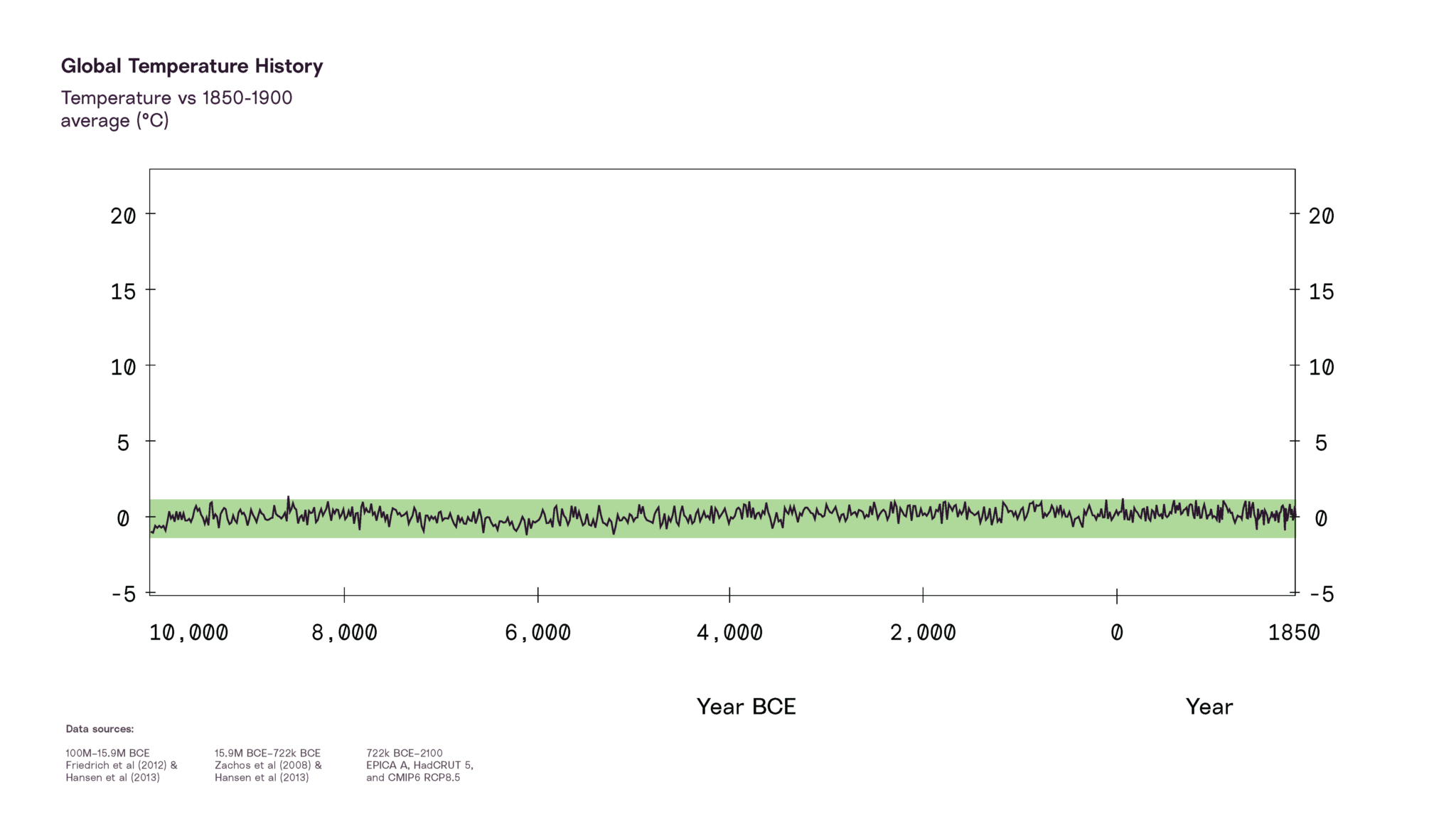
During the long stable baseline, calling the biggest storm in the past 100 years the “1-in-100-year storm” was fine because you could expect that the next 100 years would be like the last one. By analyzing the recent past, one could accurately predict the future. That’s how farmers chose crops, architects and builders designed and built buildings, engineers chose tolerances and standards, and insurance companies set rates. Everyone assumed stability.
What I find so impressive about climate science is that despite this long, seemingly permanent stability, physicists, geologists, hydrologists, and others wondered if, perhaps, the future might be much different. Some scientists mused about climate change as early as the mid-19th century, but, especially after space exploration revealed to us just how special our planet was, scientists at NASA and other centers like the Lawrence Livermore National Laboratory turned some of their attention away from making rockets and bombs to figuring out how the climate system worked and considering the possibility of very different futures. By the 1980s, they were warning that the future was going to be very different from the recent past.
This might have been an exciting opportunity for economists to advise society on how to think about climate change, what the costs might be, and what kinds of investments would prove to be a good return for the future. The problem for economists was that although they knew the future would be different from the past, their discipline had become an “empirical science,” which meant that they could use data only from the recent past.
William Nordhaus, the most prolific and recognized climate economist, simply took the economy of the 20 years before each of his publications and asserted that that was how the economy would work even 200 years in the future, not because he actually believed that it was accurate but because he viewed the recent past as the only valid data. And since the recent past showed scant evidence of climate change inducing economic disruption, he forecasted smooth GDP growth in the future. He once wrote that if you put a forecast of future GDP with climate change and a forecast of future GDP without climate change on a graph together, the difference between them would be smaller than the mark made by a #2 pencil.
Subsequent economists believed that Nordhaus was wrong, but since the norms and standards of their profession funneled them toward the same backward-looking data and pretty much the same techniques, they arrived at numbers that were still never larger than a 10% decrease in GDP far into the future (when people would be far richer anyhow).
Since economists’ methodologies and pathologies produced ho-hum estimates of the costs of climate change, the profession wasn’t interested. No one is excited by small numbers, and boring results don’t get published in prestigious journals, so the economics profession paid scant attention to the topic.
The Quarterly Journal of Economics (QJE) is widely considered to be the most prestigious publication in the field. Here is the distribution of articles in the QJE by topic over the past 20 years organized by the profession’s own classifications:
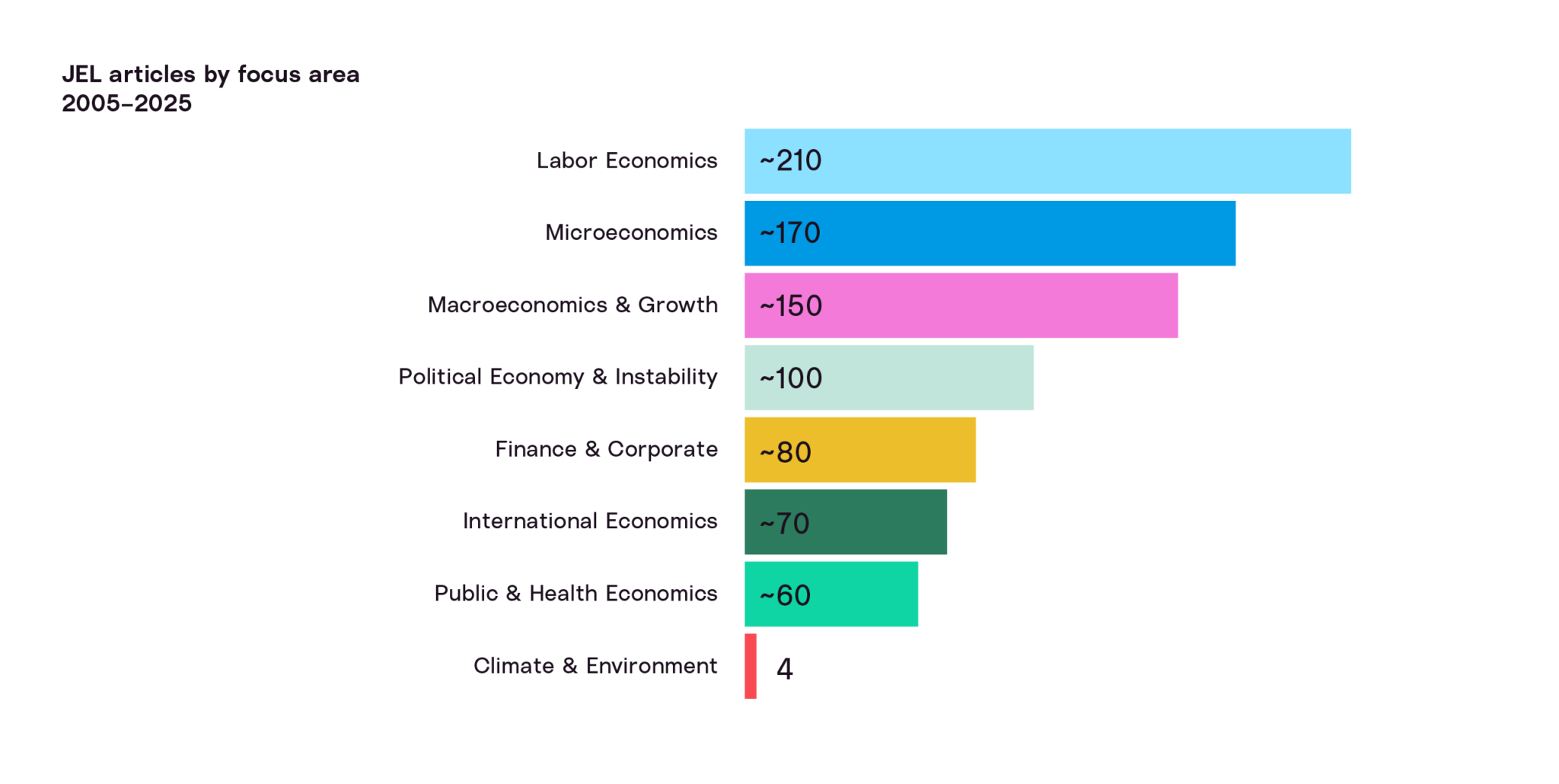
Only four of the last ~850 articles in the QJE were about anything related to climate change, but this small number contains a very interesting trend: Three of the four are about the impacts of climate change, they all appeared since 2021, and each of them declares that new data reveals that climate change is more costly, disruptive, and even lethal than previous estimates.
In the May 2026 edition of the QJE, economists Andrien Bilal of Stanford and Diego Känzig of Northwestern declare that previous estimates were off by a factor of 10.
In their article, Bilal and Känzig begin by writing, “Climate change is frequently described as one of the defining economic challenges of our time. This view, however, stands in sharp contrast to empirical estimates of its impact on economic activity: They imply that a permanent 1ºC rise in temperature reduces world output by 1%–3%.” In contrast, Bilal and Känzig find that “a permanent 1ºC rise in global temperature lowers world GDP by over 20%.”
Why do Bilal and Känzig find a much larger effect than their predecessors? Part of the answer is likely because their baseline data now includes much more climate change. But the other part is that, having seen more evidence of climate change, the authors have a better sense of how climate change might affect the world. While previous studies all homed in on local effects, treating weather in every country separately, Bilal and Känzig hypothesize that when the global temperature rises—causing droughts in some places, deluges in others, etc.—the whole world lurches away from a stable baseline, with much more lasting damage for the global economy. In fact, they estimate that “...world GDP per capita would be more than 20% higher today had no warming occurred between 1960 and 2019.”
I admire the authors for their creativity and diligence (and can only imagine how many methodological questions they got from editors). The authors sincerely try to go back further than most research does. One of their two datasets goes from 1860 to 2019, while another goes from 1960 to 2019. These datasets contain the kinds of information you’d expect from an economics dataset, and their analysis uses clever but orthodox econometric techniques. They are earnestly trying to help us look to the future, but their approach is like navigating by looking in the rearview mirror to decide where to go.
Getting older information about fisheries was valuable to marine biologists, but climate data is peculiar. Even going back a couple hundred years to figure out the impacts of climate change is of limited value. For 12,000 years, the climate was stable, and from 1850 to 1980, it barely moved. Only in the 2010s did the average temperature pass 1.0°C, thereby leaving the range of the past 12,000 years.
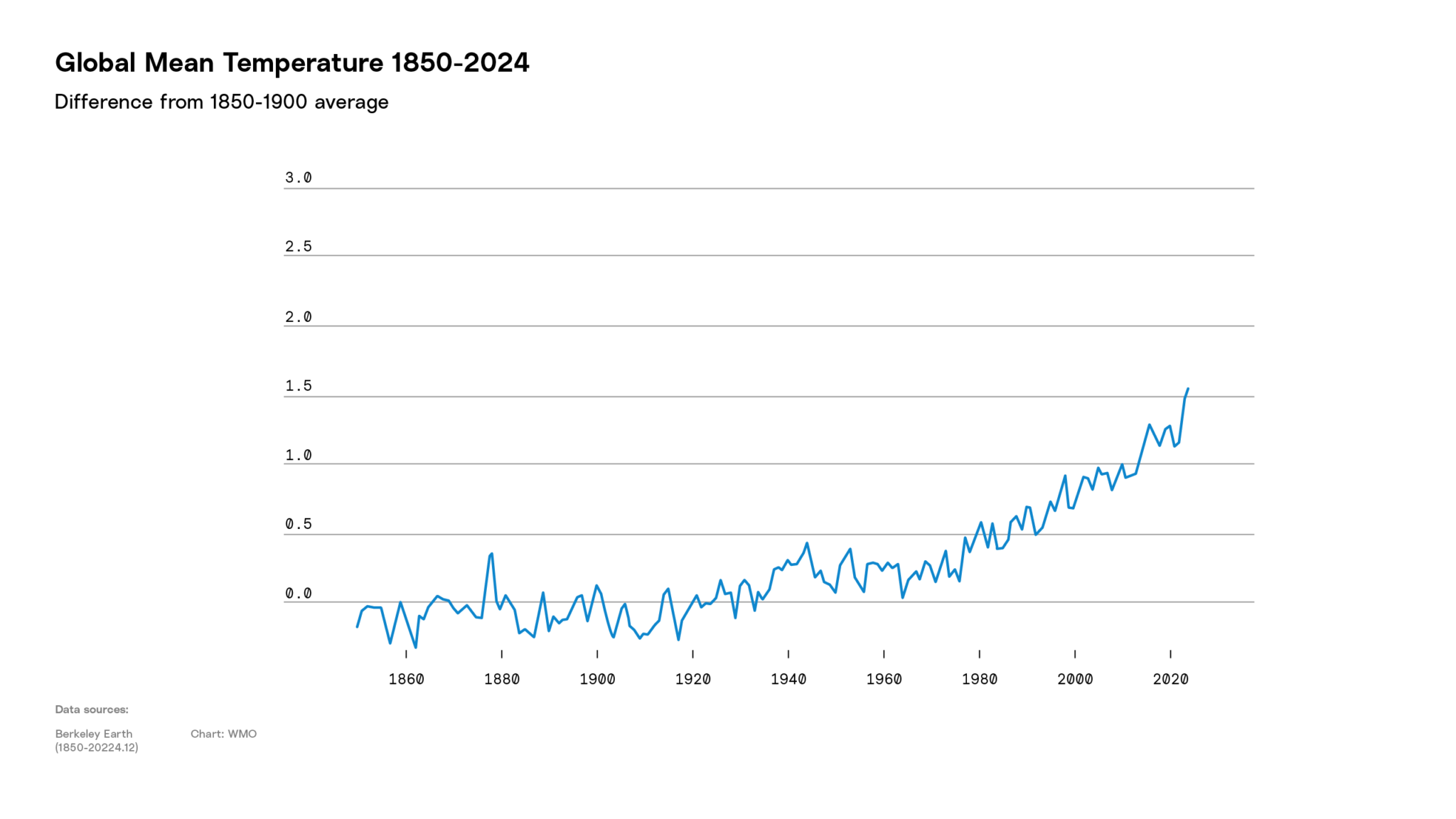
Source: WMO
But economists could embrace Pauly’s recommendation to include different data from the past. Let’s look at hypothetical residents of the same house in 1976 and 2026:
Tech CEO Steve lives in a nice house in Silicon Valley in 1976. The weather is warm but not too warm, and dry but not too dry. The summer days can get hot, but nights cool off nicely, so, like all of the other houses in the area, Steve’s house does not have air conditioning. He has a basic, cheap insurance policy. The house requires little maintenance, so there is almost no economic activity around it, but the house goes up in value as wealth rises around the area. It’s a great investment.
Tech CEO Sam lives in the same house in Silicon Valley in 2026. He has had to put a lot of money into his house in recent years. First, he needed air conditioning because, thanks to the greenhouse effect, nights no longer cool down the way they used to. Then he needed to get air filters because the wildfire smoke was so common. Now he’s cutting back the trees and other plants around the house, changing the roofing materials, and putting new covers on the dryer and other vents to make the house less likely to burn down in hopes that he will qualify for expensive wildfire insurance. Plus, the smoke has made asthma more common, so Sam and his kids see a pulmonologist and take more medicine.
Sam’s spending is not making his house more valuable or helping his kids sleep better than Steve’s did. His expenditures are simply replacing what nature used to provide for free and keeping the house from losing value. No one wants to buy a house without AC and air filtration in Silicon Valley in 2026, and no one wants a house that may burn down or can’t be insured. Sam’s spending is adding a lot to GDP, but wealth is not rising accordingly.
This relationship between GDP and wealth reveals a second problem that economics faces when considering climate change. Because building a model of even a local economy, complete with capital markets, is too complex, economic scholarship focuses on economic activity, not wealth. This may sound like a semantic argument, but it’s not. GDP is a measure of how much people in an economy produce. The implicit argument in climate economics is that if people are producing more, they are better off, but thatSilicon Valley house has become less productive because it requires more investment to deliver the same safety and comfort.
But perhaps this backward-looking tendency is purely an academic problem. Let’s examine entrepreneurs’ and investors’ relationships to the past and future.
A myopic opportunity
Entrepreneurs tend to be attentive to change, and some are noticing that climate change destroys wealth. In particular, the fires in Pacific Palisades and Altadena destroyed a lot of expensive real estate. (Flooding and storms have caused similar losses elsewhere.) So companies are popping up with new data that they claim will lead to fewer losses. These include hyper-precise wildfire and flood modeling, real-time wildfire and flood monitoring, and various forms of certification to help insurers better estimate risks.
Earlier this spring, I attended and spoke at a conference for these kinds of companies. There were representatives of dozens of small firms there, handing out business cards and looking for customers or investors, while employees of a handful of the more established climate intelligence companies showed their wares and handed out swag. Each claimed to have a better measure of the risk your house, factory, or infrastructure would flood, burn down, blow away, or be damaged by extreme heat, wildfire, flood, etc. They used sensors, satellite images, novel databases, and lots of AI to get these insights.
These companies are mostly trying to offer their services to two groups: insurers and investors. And since the recent decades have seen markets rise steadily with few really big interruptions, they have been acclimated to smooth sailing. In terms of generations, it has been nearly 20 years since the 2008 financial crisis, so that memory is gone in most institutions, and financial firms are overwhelmingly led by optimists.
As a result, analysts from insurance to banking to money management all create spreadsheets that they “true up” every year to the latest data and forecast smooth growth into the future. What they want from any new data provider or someone selling insight is the ability to plug a tidy result into these graceful spreadsheets.
I asked many of the companies at the conference if they were offering insights about how the future would be different. They all said no. They can provide up-to-the-minute estimates of the likelihood that your house burns down or floods, but they all said in different ways that creating informed estimates for the future would be too hard. There are too many variables and too many dynamics that are without precedent in their backward-looking data. They would be unable to produce precise estimates of the costs and benefits. So even the climate intelligence community is mostly selling a version of the recent past. It’s essentially an updated baseline, but it’s not a view into the future.
Here’s an example of what I’m talking about:
For a fee, the company Jupiter Intelligence will tell you exactly how high to put your loading dock so that your warehouse stays dry during a storm surge and how much money you will save by doing so. Their proprietary models of flood risk spit out precise estimates of water levels, using data about buildings, sewers, levees, curbs, roads, weather, and climate. In April of this year, Jupiter put out a new report, “Pricing the Tipping Point: Economic Consequences of an AMOC Collapse.” I wrote about the AMOC in my last essay, and Probable Futures recently published an excellent AMOC explainer, but because I want to show how companies are currently dealing with risks, I’ll let Jupiter’s report explain it:
The Atlantic Meridional Overturning Circulation (AMOC) is a system of ocean currents that transports heat from the equator to the poles. A strong AMOC circulation is important for global climate and energy balance, but climate change is slowing down this circulation. If the AMOC slows down too much, it could collapse entirely. This collapse would dramatically alter global weather and climate, particularly in North America and Europe, and would accelerate global warming even further.
Previously, climate scientists thought it was unlikely that this extreme state would be reached this century—and models still show it to be a low-probability event; but recent work has suggested that we may be closer to this climate tipping point than was previously thought, and that a mid-21st century AMOC collapse is possible at probabilities we can’t ignore.
If AMOC collapses, the effects will be big and wide-ranging. European winters will get a lot colder, seasonal rain patterns and the critical monsoons in the Amazon, Africa, and South Asia will change, and ocean ecosystems will face massive disruption. A conservative list of things that might interest an investor includes: a giant recession, big changes in asset markets, problems with bank solvency, interest rate instability, and other determinants of portfolio value. But more broadly, would there be mass starvation? Migration? Wars? Inflation? Demands for government spending to repair infrastructure? And if people in India, England, France, Norway, Brazil, and the low-lying islands of the Caribbean start to worry about these scenarios, will they be likely to do something new and potentially disruptive (like start modifying the atmosphere) to avoid the problem before 2050? To borrow from Bilal and Känzig: If something huge is happening to the global climate, looking at local changes is very unlikely to be the best way to assess impacts.
So Jupiter faces a conundrum. The firm wants to “price the tipping point,” but can’t estimate a price for any of the big things that might result from AMOC collapse. The only consequence of an AMOC collapse for which Jupiter finds a precedent and has data is the risk of flooding on the East Coast of North America. AMOC pulls water away from this region toward Europe, and if AMOC stopped, there would be approximately 50 cm of additional sea level rise from Florida up to New England. So Jupiter calculates that price and puts its analysis in investor language.
The firm creates a hypothetical portfolio of 16,000 commercial and residential properties across the East Coast with a current market value of $14.1 billion. It then estimates how much it would cost the owners of this portfolio if a 1-in-100-year flooding event occurred with and without AMOC collapse. To get a precise estimate, Jupiter assumes that future costs from flooding would be of the same magnitude as past costs from flooding. It finds that a 1-in-100-year flood today (i.e., a flood with a 1% chance in 2026) would cost the owners of this portfolio 3% of its value ($356 million), and that in 2050, with a failed AMOC, the new 1% chance flood would cost the owners 8.5% of the portfolio’s value ($1.2 billion).
The implicit business plan of Jupiter and its peers is that climate change is a big deal, and investors would be wise to pay for hyperlocal insights about specific risks. But this report, about something that would radically change the world, does the opposite. The headline number of $1.2 billion in additional losses may sound like a lot, but it’s not. If I am a spreadsheet-loving investor in New York who decides which assets my private equity firm should buy, this study tells me that if we take our clients’ money and randomly buy 16,000 residential and commercial properties across the East Coast without considering climate risk, there is currently a 1% chance that the portfolio loses 3% of its value. And if a fundamental component of Earth’s climate collapses, then even in a low probability event like a 1-in-100-year storm, the portfolio would only lose an additional 5.5% of its value 25 years from now. That’s probably less than a normal recession. What a relief! I don’t need to worry about this AMOC stuff at all!
I want to be clear: The fundamental problem here is the way the cultures, norms, and standards of economics, finance, business, policy, journalism, and many other aspects of life have become so dependent on having precise numerical estimates informed by recent data that they focus on whatever the recent past can tell them even when they know that the future is likely to be very different. After pages and pages of precise numbers about low probability flooding in a few markets in the U.S., Jupiter’s report offers wise advice:
More broadly, for corporations and public-sector organizations across sectors, this analysis reinforces the importance of resilience planning and operational continuity under changing climate conditions. Large-scale circulation changes such as an AMOC collapse would interact with existing vulnerabilities in infrastructure, supply chains, labor markets, and public services.
Evaluating these interactions through scenario-based analysis can help organizations anticipate disruption pathways and identify adaptation measures that reduce exposure and enhance system robustness.
In other words: This won’t be solved with a single insight or a simple transaction. We are going to need to get together, talk with people from a variety of different perspectives, and consider both the things that we can forecast with some precision and the things that we can imagine and reason about but can’t estimate with precise numbers. If we do that, we can make good decisions under uncertainty. Instead of spreadsheets with single, precise forecasts, we are going to need to use scenarios.
That’s what people who had their baselines wrecked by nuclear bombs did.
Learning from Dr. Strangelove
World War II reset a lot of baselines. All of a sudden, nuclear devastation was an outcome with a meaningful positive probability; mass human barbarity was a novel threat that had both precedent and a playbook; and it was clear that people on the other side of the world could influence your life, no matter where you lived. In response, people, institutions, and nations, often led by the U.S. (which was the only rich country that wasn’t in ruins), undertook two kinds of initiatives. The first was to make friends, and the second was to find new, productive ways to consider the future. This essay is focused on the latter, but I want to take a short detour to explain why making friends was a highly strategic policy on which governments and corporations spent a lot of money.
Setting aside the banal fact that having meaningful relationships is what makes life worth living, it’s worth itemizing strategic values of friendship as they were seen at the end of WWII. After millions of people died in previously unthinkable ways, making friends was seen as a strategy to make the unthinkable less probable. First, having more friends limits the number of people who might become your enemies. Second, actually being a friend increases your ability to empathize with other people, which helps avoid misunderstandings and allows you to prevent conflict. Third, new, different friends expose you to ideas from outside your narrow circle, which can reveal new possibilities. And fourth, experiencing life with diverse friends (and learning their histories) can make you better at anticipating how others might react in bad scenarios. Some “friend-making” policies and institutions like the United Nations, NATO, and the World Bank were designed and funded after WWII to create formal relationships between diplomats, government officials, and institutions, but others were literally to build friendships. The U.S. started the Fulbright Program to pay for recent university graduates and graduate students to come to the U.S. to conduct research for one year, and for U.S. graduates and graduate students to go to other countries to do the same. The program was specifically designed as “a bold investment in global peace.” [I was a Fulbright Scholar in Germany in 1991. This summer, I will visit several people I met then who are still dear friends 35 years later.]
WWII so disrupted people’s baselines that making the unthinkable less probable was only one side of the strategy. Institutions, from the U.S. government (especially the military) to corporations, sought ways to make things that weren’t in the rearview mirror—the new unthinkables—easier to imagine and consider. The U.S. military funded Project RAND (“Research ANd Development”), which brought together a wide variety of people to imagine the future of weapons and warfare. The organization hired economists who were experts in both economic theory and rearview mirror data, along with political theorists, historians, mathematicians, psychologists, and others. They posed questions like “How would Iran react if it were attacked by the United States?” and thought through the various possibilities. RAND (which became one of the first nonprofit think tanks) was in Los Angeles. One of its analysts, Herman Kahn, started hanging out with screenwriters and directors, telling them stories of how other nations would use nuclear weapons. The scriptwriters called these stories “scenarios.”
Kahn grew up with a great deal of instability, moving from the Bronx to Los Angeles after his parents divorced, then serving in Burma during WWII. He studied physics and mathematics at UCLA and Caltech. He had strong opinions and boasted about the lack of emotion with which he could contemplate mass death. He wrote books with such titles as On Nuclear War and Thinking the Unthinkable. He wanted to make sure that society didn’t take dangerous risks. Most people see a mushroom cloud and stop thinking. Khan thought further. On Nuclear War is concerned with being able to win a nuclear war. This may sound crazy to you, but it’s a great question because it seems so unthinkable. In particular, Kahn considered what a society could do to be better prepared to survive a nuclear war and thrive after the war. For example, he recognized that some food would be contaminated by radiation and proposed that such food should be fed first to very old people because they wouldn’t have much time to develop cancer. He proposed comfortable bunkers under cities and towns and produced cost estimates. And he wrote about how, since people acclimate to their conditions, descendents of the survivors would probably be pretty happy. Kahn explained the strategic value of these ideas: If the U.S. were prepared to live well after a nuclear war, the Soviets would be very reluctant to use their bombs.
Kahn understood physics and math, but mostly thought through how people and societies would react. This was the value of deep history with all of its illuminating tales and disciplined speculation. Only with such thought would a person come up with the idea of a “Doomsday Machine” that would guarantee a nuclear attack on the Soviet Union, even if everyone in the U.S. was already dead.
And here’s the thing: The American public listened to Kahn. There was an appetite among people who, having experienced shocking events, didn't fully trust conventional methods of analysis. His books sold well. He went on a speaking tour and drew sizable audiences. The point of all this thinking and writing and speaking was clearly stated: The best strategy for avoiding a bad future is to first think through the probable bad futures and creatively consider both how you would live in them and how to avoid them.
The story of Herman Kahn inspires me because his public speaking and writing about scenarios had a big effect. Informed by his thinking, people often took action to prevent nuclear war. They taught their kids about the risks, and they wanted to know what their politicians were going to do about nuclear proliferation. What I find perhaps most inspiring is that those people who really listened to him about the scenarios didn’t just go out and build Doomsday Machines. Some wanted a bigger military and more advanced weapons, while others advocated for friend-building strategies, treaties, diplomacy, and Radio Free Europe. Film director Stanley Kubrick took Kahn’s ideas and made Dr. Strangelove or: How I Learned to Stop Worrying and Love the Bomb, modeling the crazed character of Dr. Strangelove partially on Kahn. (In Kubrick’s scenario, the Soviets have the Doomsday Machine.)
People outside the military turned to scenarios as well. The oil company Royal Dutch Shell boasts that its success is largely due to its embrace in 1970 of the practice of scenario planning at a time when its competitors were becoming forecasters. A Shell executive named Pierre Wack had learned Kahn’s methods and applied them to the oil market. When he and his team thought through the scenarios of the 1970s and 1980s, they foresaw crises from conflict in the Middle East. They convinced management to prepare by setting aside cash and reducing debt. And by the end of the 1980s, Shell had acquired many of its competitors during crises, during which the competitors were desperate. When asked why scenario planning could be so effective, Wack said, “Deep in our hearts, we would all choose a scenario with no surprises.”
By the 1970s, world wars had receded from the recent past to the archives. The baseline had shifted for many people. In addition, rational machines that could take data and give forecasts were on the rise. I look back on this time and see a shrinking of imagination among academics, investors, and corporations. Instead of thinking through scenarios and options, experts increasingly relied on data from the more recent past to follow and predict trends. Economists were becoming social “scientists” who treated backward-looking economic data about people and markets as if it were as robust as observations in physics and chemistry.
This kind of thinking worried Kahn. He thought that this slavish use of recent data would increase risk. In 1971, Kahn was interviewed by a British scholar in Davos for Radio Free Europe. In the interview, Kahn, who by then was called a “futurist” (a title easily dismissed by academics), spoke about the value of knowing the stories of much older history in order to appreciate how different the world can be, and about how the natural tendency for people to focus on “contemporary history” was being reinforced by certain professional practices:
This almost instinctive rejection of the [deep] past is then reinforced by certain educational trends both in America and in northwest Europe: the emphasis on the social sciences as practical aids in social planning, the prestige of scientific methodology, [and] the technicalization of knowledge all militate against the study of history… The intelligent attitude for the young generation [is] to say that all history is contemporary history and to build up their case from there.
Benign baselines
I appreciate that the recent past has felt strange and eventful, but from an economic and financial perspective, it has been quite smooth in most of the world: World War III didn’t happen, GDP grew steadily, and major stock markets went up. The Global Financial Crisis was almost 20 years ago, and markets resumed their rise thereafter. Even COVID had only a small, transitory effect on the compounding of wealth. So investors’ backward-looking data now contains few big financial surprises.
What does this look like in practice? An executive at a major real estate firm recently told me that his development colleagues were recommending the purchase of a property that not only is in a flood zone right next to the ocean but has all of its electrical, heating, and cooling infrastructure in the parking garage two levels down. He was trying to get them to see the various ways things would likely go badly, including potentially having to shut the building down for six months after a flood and both replace and relocate all of the critical systems to the roof or higher internal floors. And this was without even considering AMOC. I asked if he thought his colleagues would incorporate these risks or simply smooth them over in their spreadsheets. His body language conveyed weariness and frustration. He said, “People don’t really want to think. They want to transact.”
But some institutions are changing their behavior, and they are trying to get their communities, their customers, and even their peers to listen.
Tables and stilts
In late 2024, J.P. Morgan (JPM) hired Dr. Sarah Kapnick, the chief scientist of the U.S. National Oceanic and Atmospheric Administration, to advise the firm’s clients on climate topics.
Kapnick now publishes a newsletter called Climate Intuition. The April version was titled “Tipping Points: Decision making under deep uncertainty.” In it, she writes, “The lack of historic analogs and abrupt, nonlinear and uncertain nature of tipping points makes them difficult to plan for against more routine volatility risks. Scenarios and tabletop exercises, borrowed from other spheres of decision-making under deep uncertainty, can help prepare for new science or emerging shifts.”
As I understand it, much of Kapnick’s work is done in direct conversations with clients, but she has been very public as well. Last May, both of us spoke at a climate finance conference hosted by S2G. I gave a talk about physical risk with Barney Schauble, who led the development of the catastrophe bond market. Kapnick led a “tabletop exercise” (another term for a form of scenario planning) simulating two scenarios in 2030: AMOC collapse, and a super-strong El Niño. The attendees were given personas and instructions for thinking through the likely consequences with their tablemates. For AMOC, these consequences included:
- Europe will face deep cold snaps and agricultural shocks
- West Africa and South America will experience extreme droughts
- Ocean oxygenation and nutrient flows will shift—fisheries will collapse
This is not standard financial conference fare, but Kapnick told attendees very clearly that they should be thinking this way. In her remarks onstage, she gave some examples of coffee companies that had lost harvests and were now planning for a riskier future by investing in R&D for new coffee plants. But she said about this kind of thinking:
Unfortunately, it’s often only after a shock that companies are forced to do this thinking and actually act because they have this recency bias. [The companies’ executives say, “These] problems haven’t happened. I don’t need to be considering it. If I invest in that, I don’t think the market’s going to respond and reward me... It’ll be a waste of money, so I’m not going to start doing it until I’m required to do it.”
Kapnick’s observation that people and institutions are waiting for shocks before they even create a strategy is consistent with what I have seen. But even after shocks, people tend to simply reset the baseline to the recent past. Consider the Elevate Florida program.
The Floridian peninsula dangles into the same waters that used to be full of turtles. About 100 million years ago, the atmosphere was warmer, the world’s glaciers were smaller, and the seas were higher. There were no humans on Earth, and what is now Florida was a vast underwater coral reef. Now, because the atmosphere cooled, the glaciers expanded, the seas receded, and the climate stabilized, about 24 million people live on the fossilized remains of that reef. But the process is reversing. You can probably imagine what’s already happening and what’s coming.
Elevate Florida is a program led by the state government and paid for by the federal government. The program is entirely backward-looking and focused on one aspect of Florida life: flooding of private real estate. The program literally embraces the idea of a baseline. The program funds “Physically raising an existing structure above the local base flood elevation.”
The U.S. federal government is providing $400 million to 2,000 Florida homeowners (avg. of $200,000 per recipient) to elevate their homes (often on stilts) so that they are less likely to flood. To qualify, a home needs to be in a designated flood zone. In fact, the more times your house has flooded or been damaged by a hurricane, the better your chances of getting funding. Homeowners need to contribute 25% of the total costs of the elevation project, but they can borrow at a low rate from the U.S. Small Business Administration loan program. The implicit message of Elevate Florida is: “The current situation is as bad as it will get. We just need to get a little higher than the baseline. Investing more money in your home to elevate it is a good idea for everyone in the nation.” The program makes no mention of climate change, future sea level rise, or any scenario other than a slight change from the recent past.
Providing resources to those people who have suffered the most has deep roots in ethics and public policy, and I don’t begrudge the people who receive these funds. But the most likely scenario in the coming decades is that a lot of places in Florida will be in increasing peril, even without AMOC collapse. Many banks have already stopped lending there, insurance will disappear, people from other states won’t move there, and those houses will lose value. I can envision a future Florida scenario that has millions of concrete houses on stilts, fresh water supplied entirely by plants that desalinate ocean water, and vegetation suited to growing in saline soil, but it seems like everyone should be considering other scenarios as well.
Turtles, frogs, and hot water
Turtles feature prominently in the origin stories of Native American communities. The stories differ in their details, but in each of them, a turtle offers its back as a refuge in a time of rising waters. Other creatures, including humans, gather on top of the turtle and pile dirt on its back. The turtle then grows to create land for all species. Some Native American tribes refer to Earth as Turtle Island.
Columbus wrote in his journals that the turtles in the Caribbean were like land. He joked that his ships might run aground on them. Other Europeans colonizers wrote that one could walk across the water on the backs of these abundant turtles. But Europeans—who were mostly interested in gold and sugar—didn’t see these turtles as having any special significance other than as convenient sources of cheap food. They ate turtle eggs and turtle soup as they conquered the land and the people who lived on the islands and mainland. As they and those who followed them moved up what they would eventually call the American coast, the species varied, but the reports were the same: The waters were so crowded that you could hunt turtles with your hands, kill huge cod with an oar, or simply gather lobsters after piles of them washed up on shore in storms. Indentured servants in Massachusetts rioted and sued to get their masters to serve them lobster no more than three days a week. They won their court case.
In the past 30 years, following Daniel Pauly’s lead, scientists have used diverse sources of information to estimate historical turtle populations. They now estimate that in the 17th century, there were around 90 million green sea turtles and 10 million hawksbill turtles in the Caribbean. People have discovered even older sites in the Bahamas where remains of thousands of turtles were buried. These findings suggest that turtles had been even more abundant in the Caribbean before the first human explorers arrived in the 7th century.
At its low point in the 1970s, the Caribbean green sea turtle population had fallen to about 10,000. The species was put on the Endangered Species list, and conservation efforts began. Five decades of protecting breeding grounds, imposing penalties on fishing vessels that caught turtles, and enforcing other policies led to a rebound. In October of 2025, the Union for the Conservation of Nature took green sea turtles off the Endangered Species list. Take a second and guess how many green sea turtles there are now in the Caribbean. You know two numbers: 90 million and 10,000.
The answer is about 100,000. From the 1970s baseline, this is a 1,000% increase. From the 17th-century baseline, this is a 99.9% decrease.
A scenario planning exercise to ensure the health of the diverse ecosystem of which turtles and humans are a part should ask: How do we prepare for a hotter future that is getting more and more unlike the past? Whether scenario planning for turtles or humans, I have a few suggestions:
- Do not aim for “not endangered” or even “sustainable.” Aim for robust, healthy, and resilient. A community or institution whose members get along well, that has strong institutions, and has made a lot of friends among other communities and other species is far more likely to thrive even in hard times.
- When faced with risk, don’t try to be precise. Make plans that offer a large margin for error (wise investors call this a margin of safety). “Just above the current flood plain” is not a good plan.
- Build up reserves and beware of debt. The institutions that have survived hard times and even come out of them stronger hadn’t made lots of commitments based on scenarios with no surprises.
- Look for “no regret” actions you can take. There are many ways to make yourself, your organization, your community, and the wider world more resilient. These are simply good things to do, even in the best scenarios, but they are especially valuable in bad ones. Some examples include learning about risks, monitoring those risks, making plans for what you will do in the event of a bad outcome, getting to know your neighbors and your civic institutions, and finding out what assumptions your friends, family, company leaders, and fellow community members are making.
- Remember stories about turtles, birds, bugs, and frogs.
My ancestors have been in the U.S. for many generations. I assume some of them came over on boats like Columbus’s. The culture I was raised in didn’t tell stories of mythical animals beyond Winnie the Pooh. But, since the late 19th century, people of European descent have told a peculiar story about frogs.
The story goes that a frog placed in a pot of water won’t jump out if the water is gradually heated. It is a remarkable image: A man catches a frog, brings it inside, puts it in a pot with water, turns on the burner, and watches to see what it will do. Quasi-scientists in the 19th century supposedly ran this experiment and claimed that if they dropped a frog into very hot water, the frog would react violently, but if they put the frog in tepid water and heated it gradually, the frog would never move, even up to the point of being boiled. In the past few weeks, I tried to find out whether frogs would actually respond this way. The only thing that’s clear from this digging is that if a frog is not in a strange, confined, sinister pot, it will respond to threats, including higher temperatures. It will move. In fact, frogs, birds, bugs, fish, and turtles are changing their behavior as the climate changes. The biggest difference between us and these animals is that we actually know a lot about the future and are barely reacting. We are like the frogs in the story. That’s why we tell it.
The fable of the boiling frog is a warning to ourselves that we are susceptible to accepting and accommodating gradually worse conditions, to ignoring slow change. We tell this story because we recognize that we can feel trapped and unsure what to do about gradual change, even if it leads to serious harm. Consider the device on which you are probably reading this essay. If I had told you 20 years ago that little glowing rectangles would fundamentally change how children understand themselves, one another, and the world around them, and that you would feel a kind of sharp anxiety if you discovered that you had left the house (or simply gone into another room) without your phone, you would have told me I was crazy. “We wouldn’t let that happen!”
But few communities or organizations sat down around a table and did a scenario analysis of the consequences of schools accepting Google’s “free” classroom software and cheap Chromebooks, or of unregulated social media and pornography paid for by advertising, or of always being at work because your work is always in your pocket. We all just assumed the future would be essentially like the recent past. But you won’t be surprised by this story: A friend of mine went to the Bahamas with his family for spring break this year. While there, he asked a local man he’d gotten to know over the years how things had changed. “Families still come here for vacation, but now the kids don’t even leave the room. They stay inside on their phones.”
We can make better decisions and can avoid bad outcomes that aren’t very hard to imagine. We can learn from both the deep past and more recent past and use old, basic technologies like getting together at a table and talking about the future. Economists could take chances with the form and purpose of their discipline, investors could think more creatively and get out of their spreadsheets, and writers, directors, and studios could make movies that help us think in productive ways. You could convene a scenario planning session. You could even have a Dr. Strangelove movie night.
Onward,
Spencer
PS: There are perhaps 10,000 hawksbill turtles left, which makes them critically endangered.