
We wrote this explainer in collaboration with Phil Duffy, Ph.D., Chief Scientist at Spark Climate Solutions, a science-based non profit which accelerates progress on unsolved climate challenges. Dr. Duffy most recently served in the White House Office of Science and Technology Policy and was previously President and Executive Director of the Woodwell Climate Research Center. Dr. Duffy spoke to Probable Futures about Earth’s energy imbalance and the importance of researching this indicator of planetary warming.
As energy makes its way from the sun to Earth’s surface, it travels through the atmosphere as sunlight, filtering through clouds, pollutants, and gases, all of which bounce some of that energy back into space. Once it reaches Earth’s surface, snow, ice, and land also reflect some sunlight back into space.
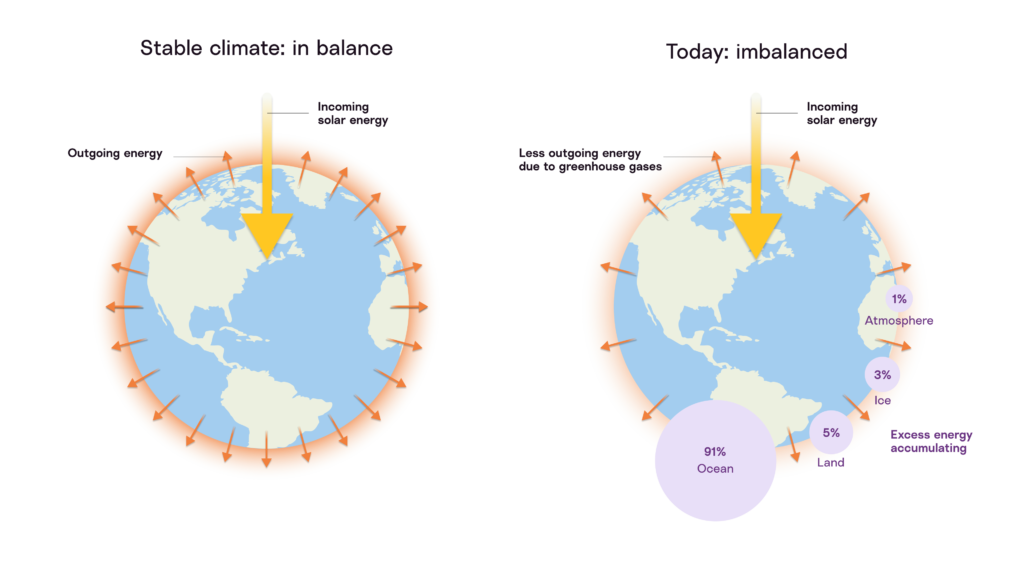
For millennia, the incoming and outgoing energy remained in close balance on average, with about 30% of energy bouncing back into space and 70% warming the Earth, creating the stable and comfortable global climate of the Holocene. Because of human activity, more energy is now entering the atmosphere than is bouncing back into space, resulting in an energy imbalance and creating global warming.
Recently, scientists have found that Earth’s energy imbalance is increasing faster, signaling that future warming may exceed expectations. Phil Duffy, Ph.D., Chief Scientist at Spark Climate Solutions, believes this acceleration tells us crucial information: “Earth’s energy imbalance is the fundamental driver of global warming. The fact that it is increasing rapidly is cause for concern.”
Earth’s energy imbalance is the fundamental driver of global warming. The fact that it is increasing rapidly is cause for concern.
What is Earth’s energy imbalance?
Earth’s energy imbalance is a measure of the exchange of energy between Earth and space. When this imbalance is positive, it means that excess energy is accumulating in the climate system, resulting in warming. When this imbalance is both positive and increasing, it means that the mechanisms causing warming are becoming stronger over time.
Scientists measure Earth’s energy imbalance in two ways. To compare the amount of energy coming into and going out of the atmosphere, they use carefully calibrated space-based instruments. To compare energy accumulating in the climate system, they use ocean floats that record temperatures both at and below the ocean surface, since oceans absorb most of the excess heat.
What causes Earth’s energy imbalance?
Changes in Earth's natural environments and atmospheric composition can influence how the planet retains or releases heat, affecting Earth’s energy imbalance. Since industrialization, the primary driver of warming has been the greenhouse effect.
Human activity has emitted greenhouse gases into the atmosphere at an unprecedented rate and scale. Those greenhouse gas emissions sit in the atmosphere like a transparent blanket on top of the surface of the Earth, allowing sunlight to enter and preventing heat from escaping, thereby heating up the planet as the greenhouse effect.
In addition to greenhouse gases, human activity emits particulate pollution by burning fossil fuels and biomass like trees, industrial processes, and other activities. These small particles affect the climate directly by reflecting sunlight back into space and indirectly by changing the reflective properties of clouds. Together, particulate pollution has masked almost 0.5°C of greenhouse warming.
Earth’s energy imbalance is changing today because of factors related to these underlying drivers of warming.
How is Earth’s energy imbalance changing today?
In recent years, scientists have observed that Earth is warming faster. For example, the rate of ocean warming from 2005 to 2025 was more than twice the rate of warming from 1960 to 2005. The World Meteorological Organization’s State of the Climate 2025 report named Earth’s energy imbalance as a “new key indicator” of global climate change, as it reached the highest value of warming since scientists started measuring in 1960. Dr. Duffy highlights the importance of these findings, saying, “If warming is speeding up, which it appears to be, that may signal the onset of new or strengthening mechanisms of warming, potentially making it harder for us to control the planet’s warming trajectory.”
The relatively steady increase in warming that Earth experienced from 1960 to 2006 was due almost entirely to the greenhouse effect. But now, in addition to the greenhouse effect, two dynamics are also increasing Earth’s energy imbalance and causing the acceleration scientists are seeing today: reduced particulate pollution and feedback loops.
If warming is speeding up, which it appears to be, that may signal the onset of new or strengthening mechanisms of warming, potentially making it harder for us to control the planet’s warming trajectory.
Reduced particulate pollution
Particulate pollution sits in the atmosphere, reflecting sunlight and helping clouds form. Because particulates can have a cooling effect on Earth, part of what is causing the current acceleration in warming is a reduction in pollution, such as soot and smog, from industrial activity. With fewer particulates in the atmosphere, more sunlight is reaching Earth’s surface.
Feedback loops
Global warming from greenhouse gas emissions has now initiated mechanisms in some of Earth’s systems that respond to warming by generating further warming, called feedbacks or feedback loops. These feedback loops are causing self-accelerating cycles of warming within Earth’s climate system.
There are a few key feedback loops that are likely contributing to the recent acceleration in warming:
- Decreasing ice cover (albedo loss). Albedo describes how different surfaces on Earth reflect sunlight. As temperatures rise, sea ice and glaciers are melting and permafrost is thawing, reducing reflective albedo cover that usually cools the planet. Because of increasing albedo loss, less sunlight is being reflected and oceans are absorbing more heat, leading to overall warming and further melting.
- Increasing water vapor. Warm air holds more moisture, and that additional water vapor in the atmosphere can act as a greenhouse gas, trapping heat and leading to further warming.
- Less low cloud cover. As Earth warms, clouds change in ways that can impact warming. It appears that warmer land and ocean temperatures reduce the low cloud cover that usually blocks sunlight from reaching Earth’s surface while increasing the high cloud cover that traps heat.
- Warming-induced greenhouse gas emissions. Warming temperatures are prompting natural processes like permafrost thaw, microbial activity in wetlands, and forest wildfire to emit greenhouse gases. Scientists believe that these warming-induced emissions are a major contributor to recent rapid increases in atmospheric greenhouse gas concentrations.
What Earth’s Energy Imbalance tells us about the future
We need to urgently prioritize research of Earth’s energy imbalance. The more we understand how this imbalance is changing, the better equipped we might be to manage warming into the future.
Earth’s energy imbalance tells us about the inertia of the planet’s warming. While degrees of warming tell us how much the planet has warmed already, relative to preindustrial averages, Earth’s energy imbalance provides clues about how it may warm in the future.
Dr. Duffy supports further investigation into how warming is changing, saying, “We need to urgently prioritize research on Earth’s energy imbalance. The more we understand how this imbalance is changing, the better equipped we might be to manage warming into the future.” Understanding the role of feedback loops in Earth’s warming can help us plan for a warmer, less stable future, in which we need to manage Earth’s systems in addition to controlling greenhouse gas emissions.
Was this article helpful?
Thank you. Your feedback helps us improve.