I am typically uneasy when people ask me what they should do. But if they press, I will offer them this advice: Decide what you value, seek accuracy, and distrust precision. This answer can come across as obvious or oblivious, but I think it’s worth explaining why a long period of stability has made it surprisingly easy to lose track of values and to mistake precision for accuracy. And since that long stability is over, we are going to be forced to make new, difficult value choices and confront hard decisions with imprecise information.
To demonstrate how stability led to precision and to illustrate the dangers of precision when the truth is fundamentally uncertain, I’m going to use a few props: arrows, targets, butts, ships, a coffee shop, and some retirement homes. And don’t worry, AI will feature in the story, albeit probably not in the way its proponents intended. I hope you’ll find this entertaining and useful.
Let’s start with archery.
An accurate archer’s arrows will all land near the center of the target. A precise archer’s arrows will all land in almost exactly the same place, even if it’s not the center of the target.
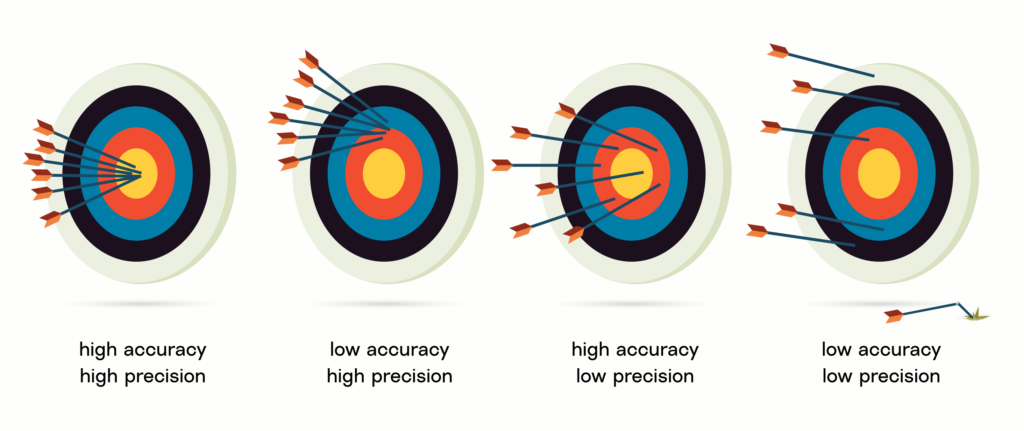
Sharp projectiles are as old as humans. Our ancestors on every continent hunted with spears and arrows for millennia, and tribes with more accurate and precise hunters fared better, so people practiced on trees, rocks, and other targets. After communities domesticated plants and animals and built villages and towns, the main use of spears and arrows was in wars. In England, where wars were common, a section of town was often set aside for target practice. In these hillsides, quarries, and fields just outside the town walls, archers could practice by aiming at mounds of dirt called “butts.” Some towns in England still have areas called butts. Archers would either hit the butts or miss.
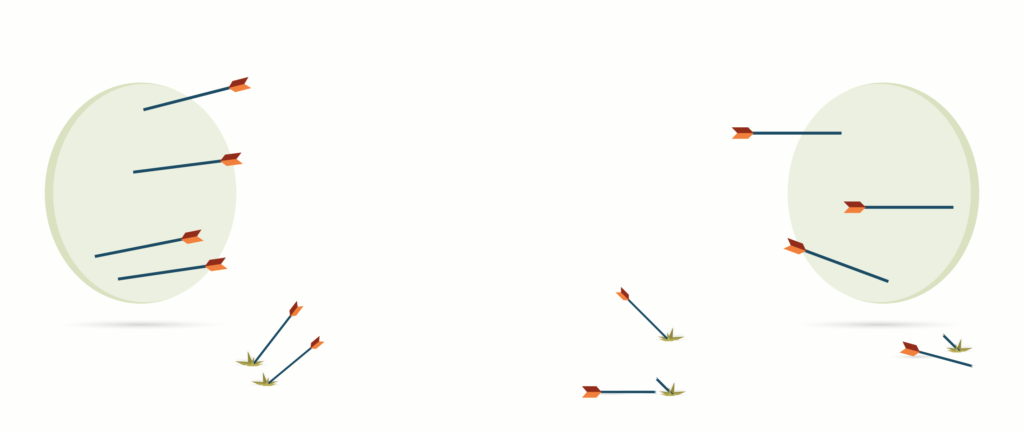
Humans are ingenious tinkerers, so equipment gradually improved. And due to our species’ growing numbers and powers and our chronic inability to get along, enemies on both sides of every border improved their techniques and equipment. So not only could archers get more accurate, they could also get more precise—and they needed to get more precise to avoid losing a war. Shooting ranges introduced rings to their targets to measure and reward both accuracy and precision.

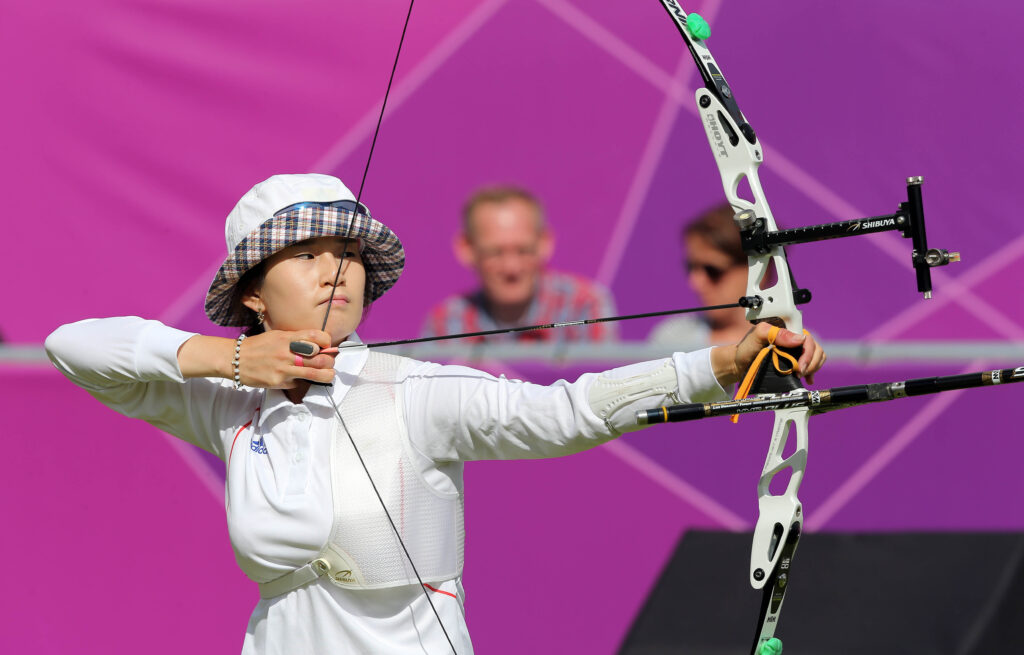
By the 17th century, bows had given way to guns for both hunting and fighting, but something about bows and arrows continued to fascinate people, and industries grew up to feed people’s desire to shoot arrows more precisely. Consider the gear that Olympic gold medal winner Ki Bo-bae of Korea used in the 2012 London Olympics:
I’m going to push my archery metaphor pretty hard in this essay, but I think it’s appropriate. If you look into the history of the English language, you’ll find that “target” and “bullseye” are used far more commonly now than at any time in the past. Farmers have a target yield; investors have earnings targets and price targets; fitness apps have performance targets; doctors recommend a target weight or blood pressure; billions of venture capital dollars are chasing targeted drugs and therapies; and marketers are targeting you every second of every day. The modern world is a sea of targets.
When economic and technological historians explain this increased precision, they highlight how markets and the scientific method led to incremental improvement, innovation, and specialization. But I think the most underappreciated factor in the rise of precision is stability. If you live in a society with wars, political upheaval, or disasters, focusing on only one small target is dangerous.
The photo of Ki Bo-bae is an exemplary demonstration of what stability enabled. We know she’s not chasing wild prey or fighting people who are trying to kill her because her clothes are pristine white and her gear is unwieldy. She wears a bucket hat not because it’s stylish (although it definitely is) but because it shades her eye and blocks her peripheral vision. She has trained—and competes—under pristine, predictable circumstances. Almost every one of her arrows hits the bullseye from 70 meters (240 feet) away, and it’s inconceivable that she’d miss the target altogether. (In her press conference after winning gold, she apologized to her team and nation for her one errant arrow that was blown off course by a gust of wind, missed the bullseye by a few inches, and received a value of 8 instead of 10 for the dead center. “Koreans don’t shoot 8s,” she said.) Unlike archers from hundreds or thousands of years ago, Ki has refined her skill under extremely stable, specific, safe circumstances.
Olympic archery might seem like an esoteric facet of modern life to focus on, so let’s bring this concept closer to home.
Safe as houses?
The oldest evidence of solid, enduring human structures is from about 9,500 BCE. That means for the first 200,000 or so years that human beings like you and I were walking around, trying to hit prey and foes with spears and arrows, there is no evidence of someone building a sturdy house. The historical record of temperature gives a good idea why this was likely true:
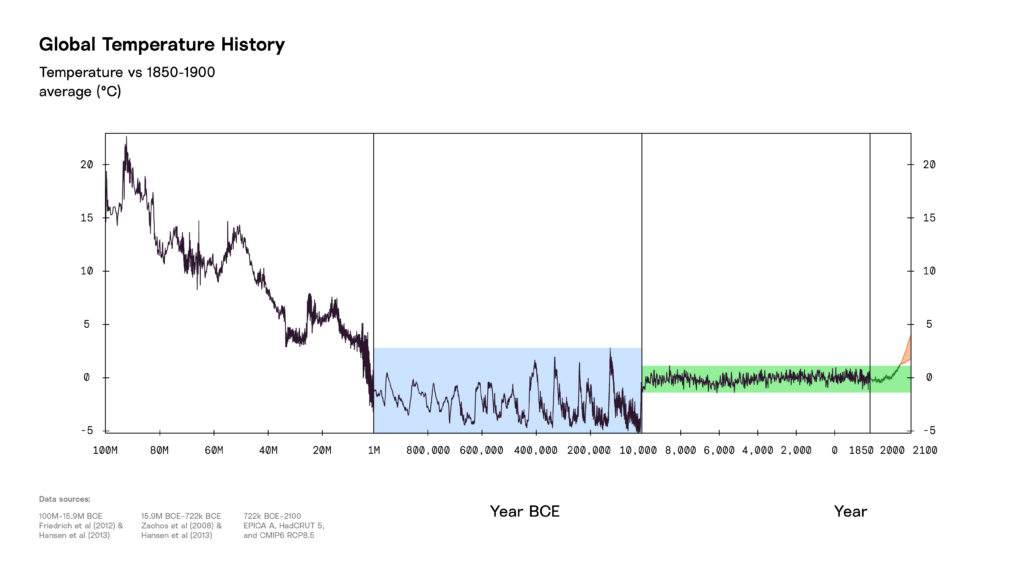
Until 9,500 BCE, the climate was unstable, and people were constantly moving. It doesn’t make sense to invest in a house or build structures that will last a long time if you are always going to be moving. And if you’re hunting and gathering, your community is likely to be relatively small, its members will be generalists, and knowledge will be handed down from person to person.
After the climate stabilized, however, people in various parts of the world started building homes, storage facilities, commercial properties, etc. At first, they didn’t have any construction history to draw on, so early structures were very basic and not very comfortable or very safe. But in societies that were stable for long periods of time (e.g., the Aztec, Mayan, and Roman empires), architecture and building practices were recorded, codified, and became precise.
In the 19th century, people started using the idiom “safe as houses.” “Safe” in this context meant not only secure but stable and easy to predict. Inside a house, one was protected from the elements, and investing in a home was considered economically “safe” in comparison with risky endeavors like investing in railways. By the beginning of the 21st century, with thousands of years of learning to literally build on, specialists in the developed world could avail themselves of techniques, tools, and standards that had been developed and refined in the past. Architects obtained certifications that assured clients that they would follow best practices. General contractors, plumbers, electricians, masons, etc., followed the norms and standards of their trades and had licenses.
People’s confidence in stability and precision was so high that tens of millions of people even moved into places that had previously been viewed as risky, putting narrow bullseyes on even the most precarious of targets: Skyscrapers inched up to the edges of oceans, mansions nestled into forests, and both farms and metropolises sprung up and spread out in deserts under the assumption that snowfall in distant mountains would lead to dependable river flows.
In this stable world, everyone assumed that the odds of even mediocre contractors missing the target altogether or a house being knocked down by wind, flooding in a rainstorm, or catching on fire were very, very low. In fact, those odds were so low that you could easily buy inexpensive insurance.
Insurance lets you try again
Even in a stable, predictable, precise world, our arrows sometimes missed their targets. Farmers lost crops even though they’d planted what government maps told them to plant. A few houses burned down even though they were fully up to code. Some cars crashed and people got hurt even though the drivers had licenses and the cars were well-built. For all of these kinds of loss, insurance policies offered a chance to try again. The farmer would get a check for the lost revenue so that she could plant again next year; the homeowner would get money to rebuild the same house in the same place; the car owner would get a check to buy a car of the same value; and the injured people would get their medical bills paid for. The deal was clear: If you followed the norms and standards and used the equipment that experts developed over time to hit a common target, an insurance company would offer to give you another arrow if you missed.
As the years went by, our databases of historical records of temperature, precipitation, and wind speeds grew. And since the distribution of those numbers was stationary, each additional observation and experiment enabled increasingly precise estimation of even low-probability events. After a few centuries of stability, insurers could simply count how often storms of different sizes occurred and divide by the number of years in the data.
Earth’s climate was so stable that, until the past couple of years, most U.S. insurers didn’t even think of climate as complex. In fact, they didn’t even bother doing their own risk assessments or hire climate scientists, choosing instead to outsource risk modeling to one of two companies: RMS or Verisk. Risks to our homes were so small and so precisely predictable that insurance literally became comical. One might think that a company making a pledge to pay you a large sum of money if something terrible happens to you would emphasize the company’s trustworthiness and rigor. But after decades of benign stability, modern insurance ads feature actors, athletes, geckos, and emus telling you that they can help you hit the bullseye of the cheapest price: The contract to rebuild your $400,000 home after it burns down could be reduced by a hundred bucks if you bundle!
And it’s not just the insurance companies. After decades of stable, gradually falling risks, even insurance regulators shifted their focus away from overseeing the solvency of issuers and the structure of markets to keeping prices low. Everyone seemed to agree: We could all take cheap insurance for granted. What a world that was.
But as the atmosphere warms, and the seas, the rains, the winds, and the fires grow more energetic and harder to predict, modern houses are becoming more like the assets that modern insurance was built to insure: 18th-century boats.
Long shots
The history of colonial trade is complex and morally fraught, but for now, please just consider 17th- and 18th-century shipowners as financial archers. Their “arrows” were ships sent off to the other side of the world with the hope that the vessel and its contents would arrive intact and be sold in Asia or the Americas, refilled with other materials, and sail safely back to England where the imports would be sold, many months after the initial launch. The potential risks were varied and hard to predict.
In the very early days of maritime trading with Asia (known to the British as the East Indies), the odds of losing a ship altogether were high. My limited reading of maritime economics indicates that somewhere around 1 in 5 or possibly even 1 in 3 ships didn’t come back. Those misses were costly to the owners. (The misses were obviously far more costly to the crew given how common disease and violence were during the journey; estimates of crew mortality in the 17th century are around 10 to 15% on “successful” journeys and closer to 50% overall.) The losses were highest during times of conflict, when rival navies would confiscate or sink merchant ships, but even without enemies shooting at your ships, losses were very frequent in the early days.
Coffee shops had emerged as gathering places for businessmen after the Great Fire of London burned much of the city in September of 1666, and Edward Lloyd’s coffee shop established itself as the place to go for shipping information. It was abuzz with news about departures and arrivals, commodity prices, political conflicts, disease outbreaks, and other matters that might affect the success of a voyage. After years of gossiping, dealing, celebrating windfalls, and losing fortunes, merchants struck upon a way to reduce the financial pain of a lost ship.
A shipowner who wanted to finance a voyage could offer a proposal to the merchants gathered at Lloyd’s: The shipowner would pay a fixed amount up front in exchange for payment covering losses should the voyage end unsuccessfully. This “insurance” wouldn’t make it easier to hit the target, but it provided money if a ship didn’t reach its intended target (the ports in Asia and back in England) but instead hit the bottom of the ocean. Insurance was like a safety net outside the target.

Seeking insurance at Lloyd’s was not a quick and easy transaction. The members of Lloyd’s were known as “Names” because when they pledged to underwrite a voyage, they were pledging their personal fortunes. The Names would gather as much accurate information as they could about the sturdiness of the vessel, the experience and reputation of the captain and crew, the route, the contents, and other factors. This rigor not only allowed shipowners to undertake risky endeavors but it helped shipowners understand risks and possibly reduce them. If the Names would not offer to take any of the risk, the shipowner would have to carry the risk alone. If the Names offered a high price, it was a risky endeavor, and if the Names offered low rates to insure a voyage, it was highly likely to succeed.
Over the course of the 18th century, British naval dominance lowered the risks of piracy and being sunk by enemy fleets; weather patterns were documented; and increasingly accurate and precise maps, clocks, and sextants enabled captains to know where they were, where they were going, and the best routes to get there safely. In the late 18th century, the British East India Company lost fewer than 5% of the ships it sent from Britain around the Cape of Good Hope to Asia and back. Thanks to all of this stability and predictability, the diligent, extensive underwriting that Lloyd’s members did was replaced by pro forma documents, standard contracts, and inexpensive policies. When the range of outcome was wide and imprecise, only voyages that offered large potential profits were economical, but after insurance became boring, merchants could afford even marginally profitable endeavors.
But the climate is now unstable, and this raises some key questions: Can we navigate the future precisely using the tools and practices we developed under stable conditions? Since climate science warned us more than 40 years ago that this instability was coming, can climate science perhaps chart a precise path to a safe port? Or are the culture, methods, and instruments of science themselves unsuited to an unstable climate?
Trajectories
Science has a lot in common with competitive archery, homebuilding, shipping, or insurance: Over time, scientists gained a more accurate and precise understanding of the stable world. Scientists explicitly documented how new knowledge was built atop the old. To make sure that the edifice of knowledge remained robust, the culture (particularly of Western science) emphasized the importance of being absolutely sure about things through repeated, careful, well-documented observations.
When I first became interested in climate science, I learned that Earth’s climate was a difficult subject for research, and that climate change was even more problematic. Here are a few reasons:
- Scientists have only observed Earth’s systems during a period when nothing much changed.
- There is only one Earth, so we can’t run experiments on lots of Earths to see what happens in different scenarios.
- The climate is too physically vast and complicated to measure or model precisely (there aren’t sensors everywhere in the atmosphere, the soil, and the ocean). So no matter how big and powerful our computers get, our simulations of nature can only be approximate.
- The climate system isn’t just complicated, it is complex. In a merely complicated system, one can study every component of the system and predict the whole. But in complex systems like the ones that combine to produce Earth’s climate, the behavior of each part is both a function of that part’s “nature” and of behaviors of other parts of the system. This means that scientists can try to isolate or simulate portions of the climate, but they can’t be precisely sure how the whole system will fit together.
Other people began asking scientists about the impact of burning fossil fuels and turning forests into pasture long before I did. Scientists’ first response to these inquiries was to answer a narrower question: “How much would the temperature of the atmosphere change if the amount of carbon dioxide in the atmosphere doubled and everything else were held equal?” This measure (change in temperature caused by a doubling of CO2) became known as “equilibrium climate sensitivity.”
In the summer of 1979, a committee of scientists and energy experts gathered in Woods Hole, Massachusetts. At the end of their time together, they published “Carbon Dioxide and Climate: An Assessment” for the National Academies of Sciences. They concluded:
We estimate the most probable global warming for a doubling of CO2 to be near 3°C with a probable error of +/-1.5°C. Our estimate is based primarily on our review of a series of calculations with three-dimensional models of the global atmospheric circulation... We have also reviewed simpler models that appear to contain the main physical factors. They give qualitatively similar results.
The committee goes on to say that although they didn’t have the capacity to model more complex phenomena:
[W]e have tried but have been unable to find any overlooked or underestimated physical effects that could reduce the currently estimated global warming due to a doubling of atmospheric CO2, to negligible proportions or reverse them altogether.
In other words, they estimated that doubling CO2 would result in between 1.5°C and 4.5°C of warming, holding everything else stable. Elsewhere in the report, the authors warn that there were other factors that would likely raise the upper bound of the range, but they couldn’t think of any that might lower it.
Over the ensuing 47 years, groups of physicists, chemists, biologists, paleoclimatologists (who study the past climate), and others collaborated to make more advanced models to simulate the atmosphere under different conditions. But natural scientists wanted to limit their work to the oceans, forests, soil, clouds, and atmosphere. They left the behavior of humans to others. So the Intergovernmental Panel on Climate Change created a set of scenarios back in 2006.
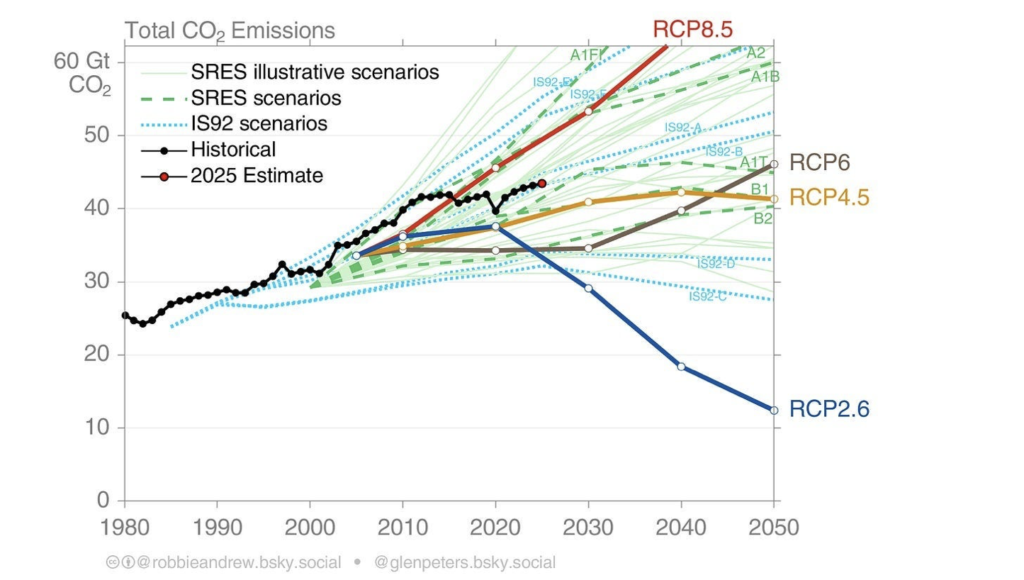
The scenarios (RCP2.6, RCP4.5, RCP6, and RCP8.5) were chosen as possible “representative concentration pathways” that CO2 emissions might follow. The black dots show actual emissions through 2025. These pathways covered a range of outcomes that all had some probability. The IPCC didn’t assign probabilities to them both because it’s not possible to assign precise probabilities to the future of human behavior. You can see that emissions are currently below the red RCP8.5 (which has at times been called the “business as usual” case but was created as a “worst case” scenario) and above the other three scenarios.
But in the 2010s, a peculiar form of climate discourse emerged that treated the pathways more like forecasts. “Which RCP are we on?” and “Precisely how much warmer will the atmosphere be in 2100?” became active debates. Energy analysts built complicated models of oil, gas, coal, and renewables, many scientists argued that RCP8.5 was “pessimistic” or “irrelevant,” and climate activists, keen to engender optimism, wanted to tell people how easy and cheap it would be to get on the low-emissions pathways. This wasn’t just chatter inside a narrow community; it affected the public’s perception of climate risk. For example, in 2019, I had several meetings with corporate leaders who told me that the only thing they knew about climate change was that RCP8.5 was “wrong.”
The accurate view of the present and the future was that a wide range of outcomes was still probable and that there was no way to be precise. But modern culture is uneasy with the idea that something can be accurate and imprecise.
Alarmed at how a culture of precision was influencing not only the public but scientific inquiry, climate scientists Phil Duffy, Christopher Schwalm, and I published a short piece in the Proceedings of National Academy of Sciences in 2019 entitled “RCP8.5 tracks cumulative CO2 emissions” to point out that we were still nearest to RCP8.5 and to push back on the idea that scenarios with a potentially low probability in the future should be dismissed. We wrote:
[It] is fundamental that scenarios are not predictions, which is why they are not associated with likelihoods (3). Rather, scenarios are used to present decisionmakers with the outcomes of as broad a range of plausible choices as possible, so as to inform their decisions. It is meaningless to characterize a scenario as “misleading”—that assumes that we know the true future and are deliberately predicting a different one. We should instead focus on how useful scenarios may be.
We examine the uncertainties in the models as well as surveys of scientists and show that:
The implied probability of occurrence similar to RCP8.5 even at the end of the century is large enough to merit its continued use. Even so, we emphasize that scenarios are not competing forecasts but rather tools to assess risk.
Unfortunately, thinking in risk terms continued to be countercultural. People want precision. In October of 2022, the New York Times journalist David Wallace-Wells published a large feature article in the paper titled “Beyond Catastrophe: A New Climate Reality Is Coming Into View”. This piece is a perfect example of the perils of fetishizing precision when in an unstable situation. Here’s the first line:
“You can never really see the future, only imagine it, then try to make sense of the new world when it arrives.”
This is not how civilization was built. For thousands of years, although they didn’t know why, people actually did know the future because it was stable. Bizarrely, after telling us that the future is never foreseeable, Wallace-Wells immediately proceeds to tell us that he can now predict the temperature of the atmosphere 80 years in the future to within a few decimal places:
Just a few years ago, climate projections for this century looked quite apocalyptic, with most scientists warning that continuing “business as usual” would bring the world four or even five degrees Celsius of warming—a change disruptive enough to call forth not only predictions of food crises and heat stress, state conflict and economic strife, but, from some corners, warnings of civilizational collapse and even a sort of human endgame. (Perhaps you’ve had nightmares about each of these and seen premonitions of them in your newsfeed.)
Now, with the world already 1.2 degrees hotter, scientists believe that warming this century will most likely fall between two or three degrees. (A United Nations reportreleased this week ahead of the COP27 climate conference in Sharm el Sheikh, Egypt, confirmed that range.)
Wallace-Wells and the scientists he quotes had become like confident archers. The range of possible outcomes had been very wide as recently as 2017 when Wallace-Wells published an article entitled “The Uninhabitable Earth” in New York magazine which wound up in everyone’s newsfeeds (and got Wallace-Wells a book deal), but by 2022, he and the people he cites were confident that they could foresee the small, precise target we (or more accurately, our kids and grandkids) were going to hit. Or to mix my metaphors, they were confident that this ship we call home would land at a port that, while not great—and quite different from the past, and probably dangerous and even lethal for some of the crew—was both not too terrible and, most importantly, foreseeable.
In fact, he says, even the range of uncertainty is small:
A little lower is possible, with much more concerted action; a little higher, too, with slower action and bad climate luck…Thanks to astonishing declines in the price of renewables, a truly global political mobilization, a clearer picture of the energy future and serious policy focus from world leaders, we have cut expected warming almost in half in just five years.
I don’t want to dwell on how badly that sentence has aged. Instead, I want to celebrate the fact that if you didn’t get caught up in precision, climate science has been an amazingly accurate guide for more than 40 years. The committee in Woods Hole in 1979 said that their estimate of the change in temperature that would result from a doubling of CO2 was 3°C +/-1.5°C and warned that the skew was probably toward the higher numbers. This September, new scenarios were released to replace the old RCPs. The images below show the paths (note that they now go out to 2150). On the left are the emissions, and on the right is temperature (it’s in kelvin, which is equivalent to centigrade but more scientific):
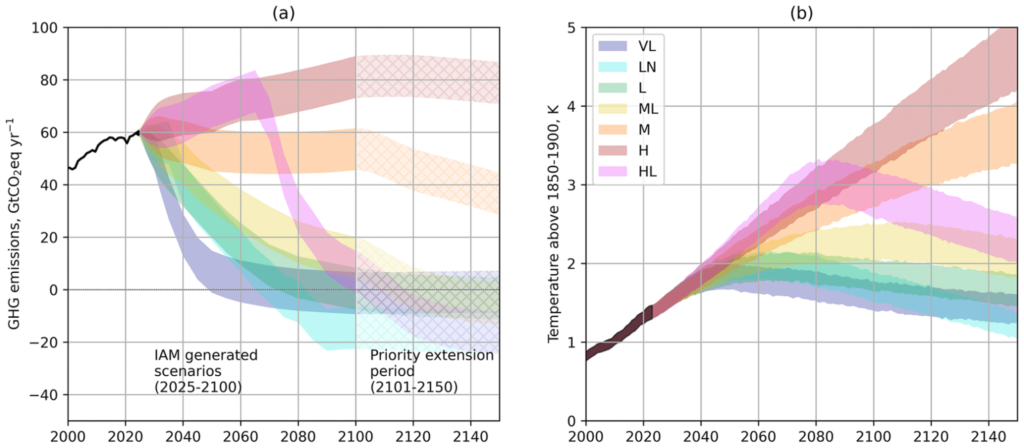
In all but the most aggressive scenarios (which you may notice include a lot of negative emissions from carbon removal technologies that don’t really exist yet), CO2 concentrations reach about 600 parts per million around the end of this century, almost exactly double the level of the preindustrial era. When the latest models simulate Earth under those conditions, they show a climate that is still around 3°C with uncertainty up to about 4.5°C. So, after 40 years of continually refining climate models, the 1979 estimates continue to be accurate.
When used properly, this body of knowledge can help us chart a safer, more valuable path forward. But to navigate safely, we are going to need to learn to make decisions with imprecise information and understand that our houses are not as safe as they used to be. We will need to change many cultures, methods, and tools, but, luckily, we can go back to Lloyd’s.
We are all going back to Lloyd’s
Risks with low, precise probabilities migrated from Lloyd’s to boring insurance companies, but Lloyd’s remained the place to go if you wanted to insure something complex, imprecise, or unprecedented. Rock stars could insure their vocal cords. Athletes could insure their limbs. Are you worried about kidnapping, terrorism, or AI models stealing your passwords? The Names at Lloyd’s would be glad to consider your risk. And now, because the atmosphere has warmed so much, people and institutions that had been getting their policies from actors, geckos, and emus are discovering that their previously boring risks are complex, imprecise, and unprecedented. People who never would have compared their assets to 18th-century ships rounding the Cape of Good Hope are finding their way to Lloyd’s.
A few months after Wallace-Wells told us we were “beyond catastrophe,” my colleague Alison Smart and I were invited to give a talk at a conference for CEOs of real estate companies. At breakfast before our session, I sat next to a couple from North Carolina who appeared to be in their early seventies. They exuded politeness and ease as they ate fruit grown in far-off places and drank coffee made by expensive machines that forced precisely calibrated water through beans grown in precise climates and roasted to precise standards. The man explained that he was the CEO of a firm that owned and managed retirement homes across the Southeast of the United States. He portrayed it as a predictable, safe business. His wife asked what had brought me to the conference, and I explained my work. At this point, the man tilted his head slightly, looked at me with the intense, unnerved expression of someone who is desperate to hear the solution to a mystery that has vexed them, and asked: “Is this why I now have to go to Lloyd’s of London every year to get insurance?” “Yes,” I replied.
I explained, “Your finance department used to be able to buy an insurance policy from a broker. Now you—the CEO—need to go to Lloyd’s every year to convince them that your retirement homes are worth insuring. And you basically have to accept the price they offer you because otherwise your loans will be in default.” His wife seemed to find it fascinating. He looked as if his fruit and his coffee were brewing up a storm in his gut.
But why couldn’t the CEO just keep getting regular insurance from the same old companies? Couldn’t his company just offer to pay a higher premium? The thing is, the atmosphere hasn’t just changed, it has warmed. And a warmer atmosphere (and ocean) has more energy, can do more things, and is even harder to model or predict. Companies that offer precisely calibrated catastrophe models now estimate that in many places, the storm, flood, fire, drought, etc., that used to have a 1% probability now has something like a 3% or even 5% probability. If that were the only change, perhaps he could get insurance for three times or five times his previous rates. But the new 1% storm, flood, fire, drought, etc., is a whole new problem. That risk can’t be estimated precisely due to the complexity of the atmosphere. (Some companies will tell you they can do this; do not trust them.) We know it will rain a lot harder somewhere, but not precisely where. We know that vastly bigger storms are now possible, but we only have historical storms as inputs into our models. We have an accurate view of the future, but it’s not precisely predictable.
I first began publicly worrying about the fate of insurance in a changing climate almost 10 years ago. Now worrying about insurance is increasingly common. But instability isn’t really an insurance problem. I am glad that the CEO can still get insurance for the buildings that thousands of retirees call home, but I hope that when he goes to Lloyd’s he asks the Names for advice about how to lower his premiums. Just as their predecessors over 300 years ago could advise a shipowner to choose a different route, hire a better captain, or strengthen their ship, we can only live well in a changing climate if we reduce risks. Entrepreneurs might come up with novel forms of insurance, but pooling financial risks for houses doesn’t actually make the houses safe. We need new coffee houses where people get together to figure out not just how to transfer financial risk but also how to reduce physical risk.
This essay will be published at the equinox: 8:05 p.m. ET on Tuesday, September 22, 2026. (The timing is, unfortunately, slightly imprecise because the mail tool we use only allows us to choose 15-minute windows.) Earlier on that day, I will have spoken at a conference of homebuilders, insurers, financiers, property owners, and engineers convened by the private client services division of the world’s largest insurance broker, Marsh Agency. Marsh wants their community to understand that outsourcing risk thinking to the insurance industry is no longer viable. The company recognizes that climate literacy needs to be part of designing, building, lending, managing, maintaining, and repairing homes. If all of the specialists who used to focus their vision on a narrow, precise target look around and ahead using climate science, houses can be safe enough to insure.
The biggest risk isn’t just costly insurance or a few unsafe houses. It’s that civilization and all of its institutions are unprepared both for instability and for life at 3°C (or more). And that brings me back to the beginning of this essay: What do we value, and how do we make choices that reflect those values with accurate, imprecise information? Thankfully, we have AI. This new technology is phenomenally revealing about these issues.
Target values
I imagine Sam Altman, Dario Amodei, and Elon Musk walking into Lloyd’s in the 18th century.
The men there possessed heterodox backgrounds, had lived through wars, considered all kinds of crazy ventures, dealt with shadowy hustlers, geniuses, rogues, and nincompoops, and had developed a sense of what risks were worth taking. They literally invented ways to share risks that made their own communities more enterprising and less prone to catastrophe. They would undoubtedly be curious to hear about Sam, Dario, and Elon’s ventures. Here’s a plausible Q&A:
Lloyd’s Names: “What is this endeavor you call AI?”
AI Bros: “It’s very hard to explain. We don’t really know exactly how it works.”
Names: “Hmm… Who will the ultimate customers be?”
Bros: “We’re not sure. Possibly companies. Possibly individuals. We just assume everyone.”
Names: “That seems vague… How big are the potential rewards?”
Bros: “Somewhere between zero and maybe half of world GDP. We don’t really know.”
Names: “Um…OK. Is this AI also available in the East Indies?”
Bros: “Yes, and we must defeat China in a war for dominance.”
Names: “War? That doesn’t sound good.”
Bros: “No, you don’t understand, we need more money to fight China to make the world safe.”
Names: “Hmm… you sound like people who like to talk about war but haven’t actually been in one. Do you even know where the Strait of Malacca is?… Anyhow, what are the risks?”
Bros: “You should probably order a large cup of coffee and get comfortable, because this is going to take a while.”
As a person who has spent most of his adult life thinking about economic history, risk, finance, and the many wonders of civilization, the AI boom is a fascinating endeavor. And having spent the past decade working on climate change, it is revealing.
For the past couple of decades, scientists have been offering an accurate vision of the future, but policymakers and investors have replied, “We need more precise estimates. We want to know exactly how much money we would save. GDP out to two decimal places is preferred.”
In contrast, AI’s vague promises and wide range of outcomes are attractive.
It has been obvious that the risk of future suffering and economic losses could be reduced by subsidizing clean energy, imposing carbon taxes, and building alternative infrastructure, but policymakers and investors have shaken their heads and said, “You’re talking about trillions of dollars. The capital markets can’t just come up with trillions of dollars for new technology.” But this year something like $2.5 trillion will appear to fund AI data centers, gas-fired power plants, and whatever else they’re going to spend money on.
And when confronted with maps like the one below, which shows the estimated likelihood of extreme drought at 3°C of warming, economists, investors, and business leaders have said, both collectively and individually and publicly and privately: “Talking about climate change is depressing. We like optimism and upside.”
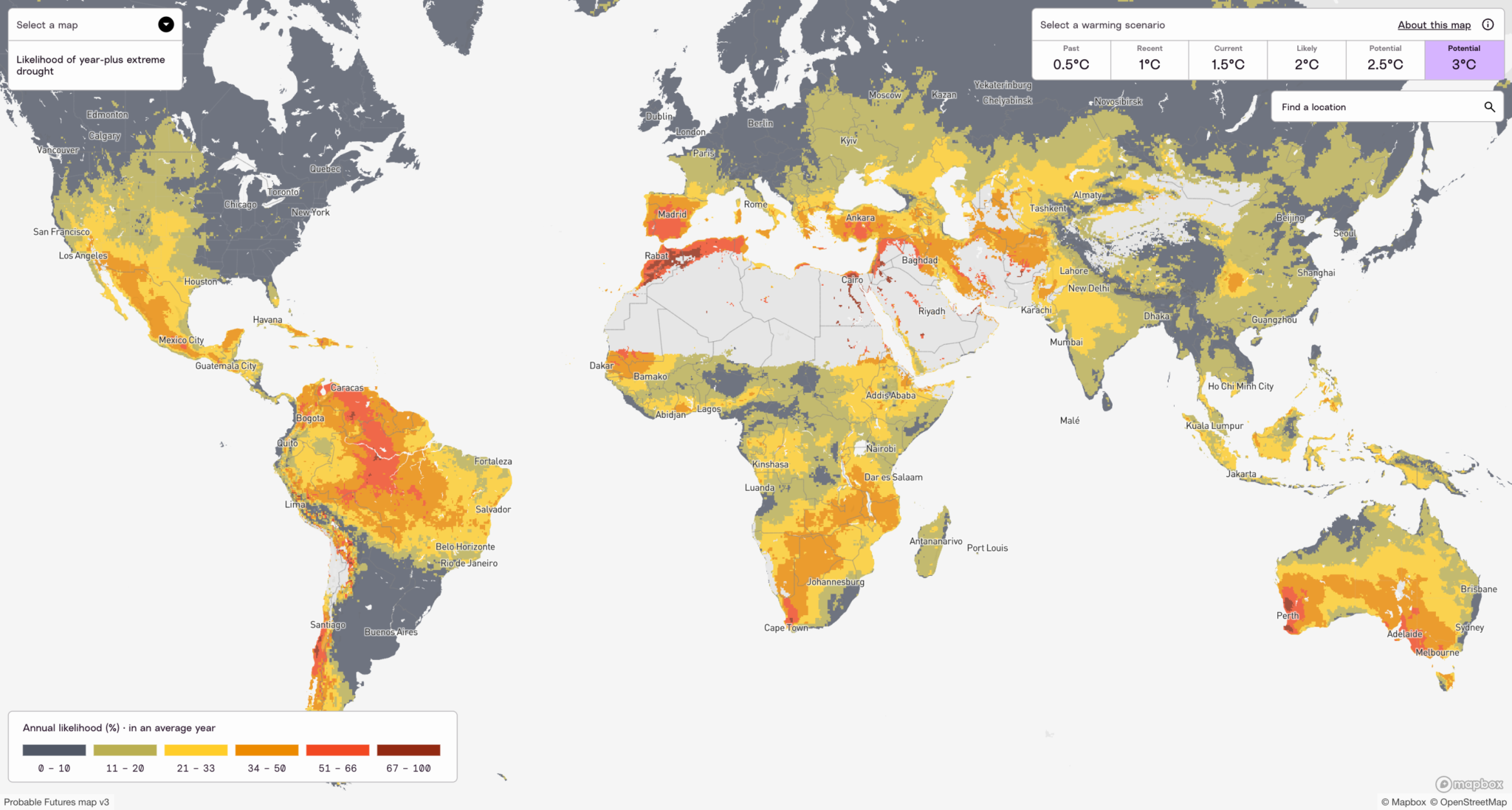
Probable Futures maps of estimated likelihood of year-plus extreme drought at 3°C of warming.
Yet the AI bros have found that the prospect of what they literally call apocalypse tends to increase valuations and open wallets.
Investors and business leaders are consistent in one way about both climate change and AI, however. At the end of conversations, especially ones in which they treat climate change as intractable and AI as irresistible, many of them remark, “I feel bad for kids, though.”
Moral values
The equinox marks the end of summer. And in London it was quite a summer. Instead of green, the parks were brown. Instead of mild, the weather was brutal. The indoor temperatures of London homes were often unsafe. According to reporting in The Guardian, tens of thousands more people died this summer in Europe than would have if the temperatures had been similar to what they were in the stable past. The future that had been foretold imprecisely is now here, and even hotter summers are coming. Europe is an increasingly risky place.
But the greatest dangers are in the places from which European shipowners, merchants, and monarchs made their fortunes: Africa, South America, and Asia. For the people in those places, colonial ships mostly brought suffering. The people who live in those places now face new, potentially even more dire threats from the rich world, but these ones are transmitted through the atmosphere instead of along shipping routes.
Below is a map of the number of days when it will be dangerous for human beings to be outside at 3°C according to a range of climate models. The colors on the map indicate the average expected number. The darkest red is more than a month. I’ve highlighted the cell that contains part of Kolkata so you can see the range. This data is imprecise, but it is accurate, and it should make us question our values.
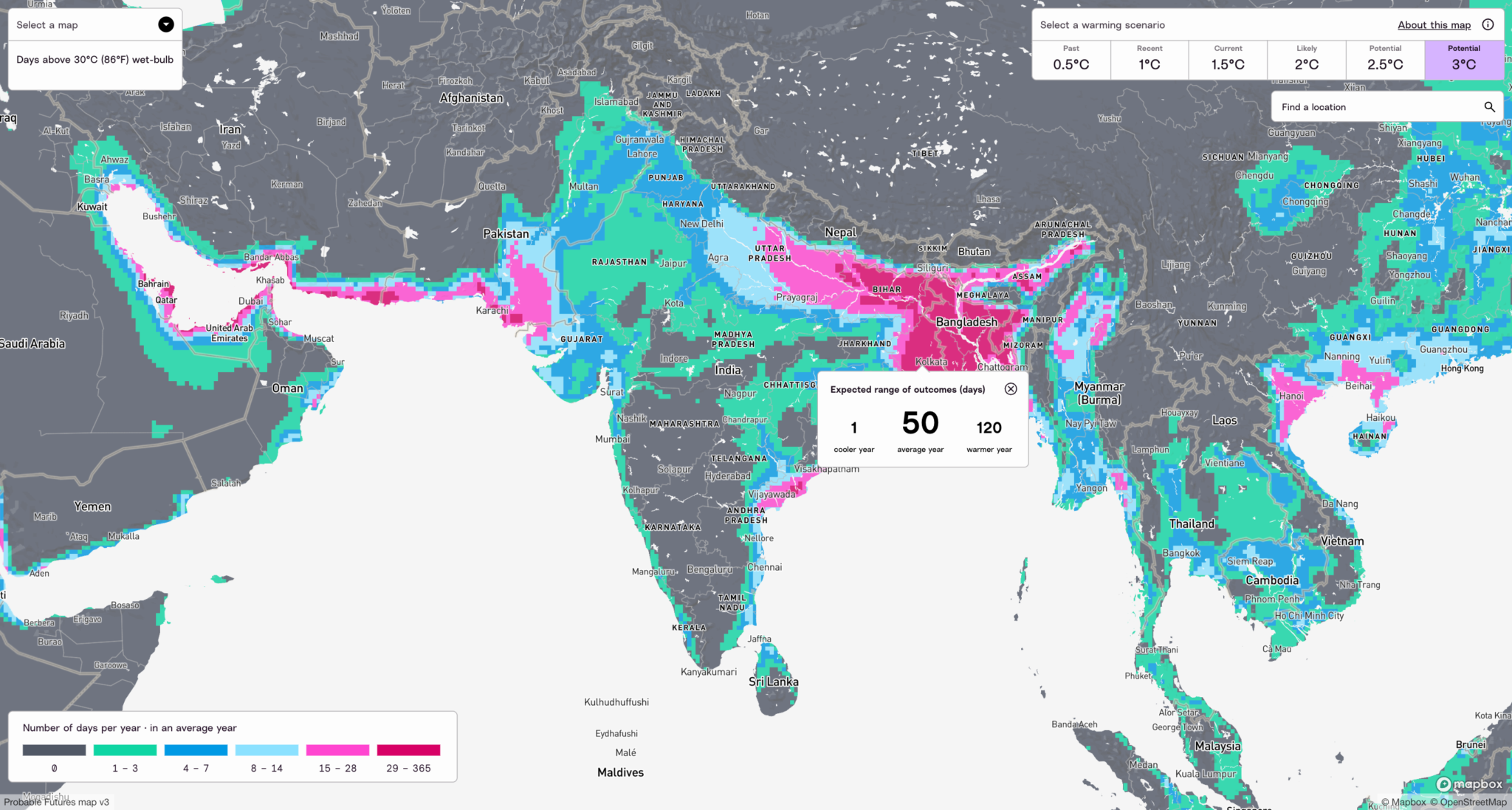
Probable Futures map of the expected range of number of days above 30°C (86°F) wet-bulb at 3°C of warming.
There is a lot we can do. Staying under 2.0°C can be an ambition but not an expectation. 3°C is a scenario, not fate. And more than 3°C is still a risk. We can convene new coffee houses, we can make our houses— everyone’s houses—more resilient, and we can help people move safely away from hazards. But to do those things, we’re going to have to choose a very different trajectory than the one we’re on. What are you aiming for?
Onward,

PS: If you’re interested in risk and climate change, Probable Futures and Harvard Business School just released a series of short videos. This one features Pete Walther from Marsh Agency Private Client Services and Ishita Sen of Harvard Business School. It’s well worth the five minutes.