All surfaces on Earth have some level of reflectivity, bouncing a certain amount of sunlight back into space, depending on how bright they are. White ice and snow cover, for example, reflect sunlight like a mirror, while dark ocean waters absorb heat like a solar panel. This reflectivity, or albedo, is declining due to climate change, and the loss of bright, reflective surfaces is now making Earth even warmer, potentially setting off a climate feedback loop that accelerates further albedo loss.
What is albedo?
Albedo is a measure of how much of the sunlight hitting a surface on Earth, such as ice, water, forests, clouds, or city pavement, is reflected back into space. It can be defined by surface type, called surface albedo, or for the planet as a whole, called planetary albedo.
Surface albedo ranges from a pure black surface that absorbs all incoming light and reflects none back into space (albedo of 0 or 0%) to a perfect, mirror-like surface that reflects all incoming light back into space and absorbs none (albedo of 1 or 100%).
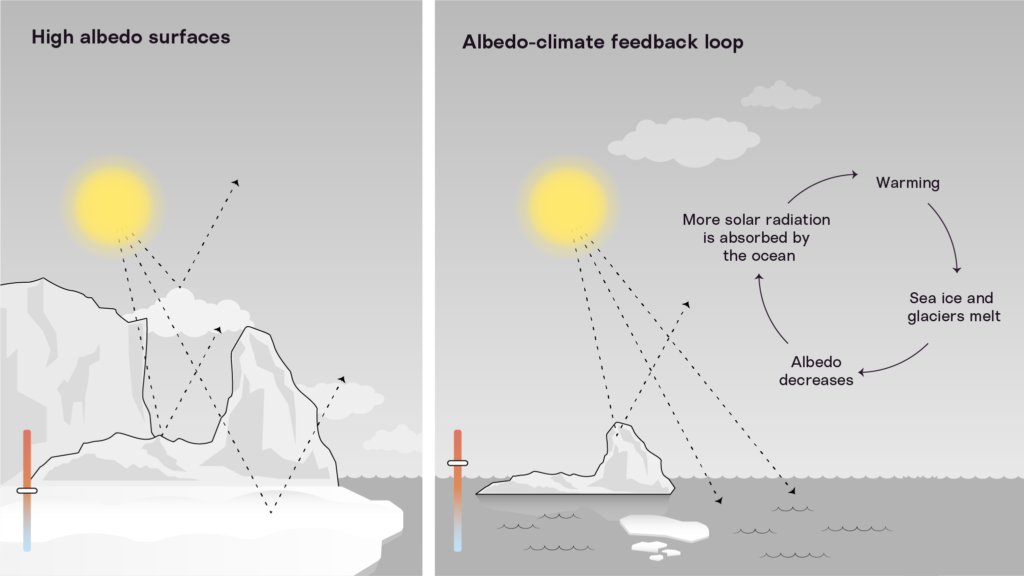
High albedo surfaces:
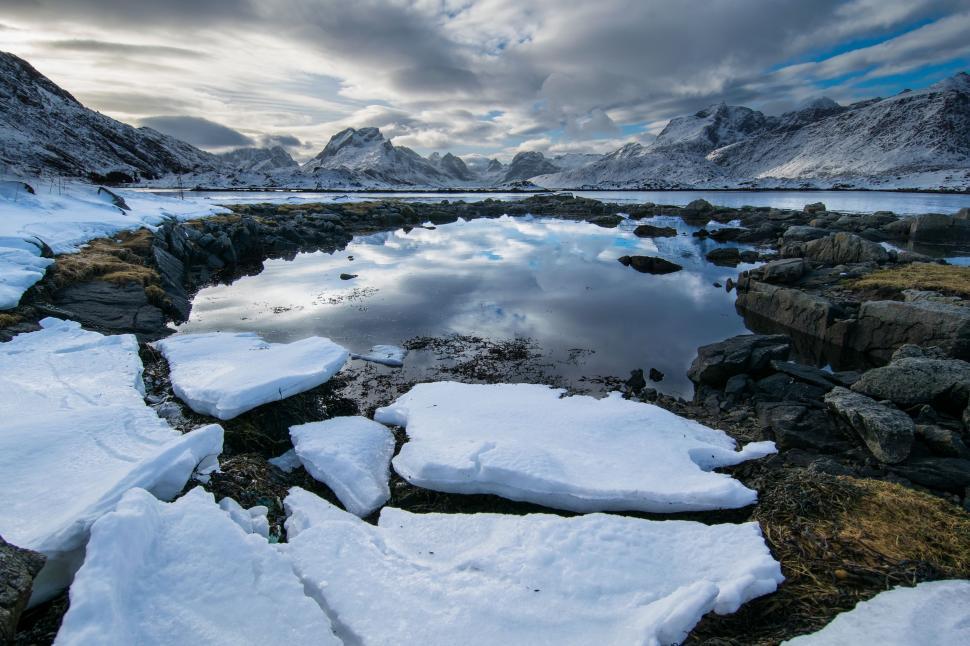
- Fresh snow and ice reflect up to 90% of sunlight.
- Clouds reflect 30 to 90% of sunlight, depending on their thickness.
- Deserts and barren sand reflect about 40% of sunlight.
Low albedo surfaces:
- The surface of the ocean reflects less than 10% of sunlight.
- City surfaces, like concrete and asphalt, reflect 10 to 20% less sunlight than adjacent cropland.
- Organic surfaces in natural environments, like leaves, grass, and wood, absorb most of the sunlight that hits them, reflecting only 10 to 18%.
Changes in Earth’s albedo directly influence how much solar energy the planet absorbs, which in turn impacts how much the planet warms. If Earth’s albedo is low, more incoming solar energy is absorbed and retained as heat. With a higher albedo, more incoming solar energy is reflected, keeping Earth’s global temperature cooler.
How is albedo changing?
Albedo is changing in ways that are warming the planet, potentially setting off a loop of accelerating albedo loss.
As of 2026, Earth’s albedo is dropping as bright surfaces like ice, snow, and some cloud types shrink. As these surfaces disappear, darker areas with lower albedo, such as open ocean and thawed land, take their place.
Humans are responsible for albedo loss in two primary ways: by directly manipulating Earth’s surfaces and atmosphere, and by warming the global average temperature through greenhouse gas emissions, which results in additional albedo loss. This warming-induced albedo loss is what initiates the albedo-climate feedback loop.
Surface and atmosphere changes
Humans have been physically manipulating Earth’s surface for thousands of years in ways that affect albedo. Together, these changes fall into two main types of human-driven surface modification.
Land use changes
When humans transform one type of landscape into another, for example, when forests are replaced by farms, wetlands are turned into suburbs, or grasslands are turned into industrial areas, the surface reflectivity of that area changes. These shifts can make an area absorb or reflect more sunlight, altering local temperatures.
Dark surfaces like pavement, roads, and parking lots have a low albedo. As humans expand the built environment, these surfaces replace brighter, more reflective natural surfaces, causing cities to absorb more solar energy. That added absorption warms the surrounding areas and continues releasing heat even after the sun goes down. This phenomenon is part of the urban heat island effect.
Land management changes
Land management refers to how people manage land within an existing land use. Choices such as crop rotation, irrigation, forest thinning, grazing intensity, and the materials used for roads and roofs can subtly change how much sunlight the land reflects. Over large areas, these small shifts add up and influence regional climate patterns.
Warming-induced albedo loss
For the last century, the majority of greenhouse gas emissions have come from human activity. These greenhouse gas emissions have warmed the global average temperature to around 1.5°C above preindustrial averages as of 2026. That warming is lowering the albedo of several key surfaces:
- Melting snow and ice. Bright sea ice, glaciers, and snowpack are all shrinking. When they melt away, the darker ocean and land underneath absorb more sunlight.
- Cloud change. As the air warms, some clouds become thinner, sit higher, or cover less area. With less cloud cover to bounce sunlight away, more solar radiation reaches Earth’s surface, where it’s absorbed and converted into additional heat.
- Changing vegetation cover. Warming shifts where plants grow, how dense they are, and how long they stay green. When darker, thicker vegetation spreads, such as evergreen forests moving north into areas that used to be snow-covered, it absorbs more sunlight.
- Permafrost thaw. As the frozen ground thaws, the surface often becomes wetter and darker. In some places, the ice in the ground melts so quickly that the land slumps and forms thermokarst lakes, water-filled pits created by collapsing permafrost. These lakes are extremely dark, so they absorb a lot of sunlight.
The albedo-climate feedback loop
The albedo-climate feedback loop describes how rising global temperatures reduce Earth’s reflectivity by shrinking reflective surfaces and exposing absorbent ones, intensifying warming, and accelerating further albedo loss in a looped pattern. This climate feedback loop is part of the reason that the Arctic has warmed nearly four times faster than the rest of the planet since 1979, as ice loss reinforces local warming, melting more ice.
The primary forces in the albedo-climate feedback loop are snow and ice loss and cloud change, although permafrost thaw also plays a role. The albedo-climate feedback loop contributes to Earth’s energy imbalance, a measure of the exchange of energy between Earth and space. Earth’s energy imbalance is accelerating, which tells us that warming is speeding up, in part due to feedback loops like this one.
The future of albedo and warming
Earth’s albedo is declining: NASA measurements since 2000 indicate a consistent downward trend in albedo, accounting for warming equivalent to 1.7 watts per square meter of solar radiation or 138 parts per million of increased atmospheric carbon dioxide. While it’s hard to determine how much this has warmed the planet’s overall average temperature in degrees Celsius, scientists estimated that albedo loss accounted for 0.2°C of warming in recent years.
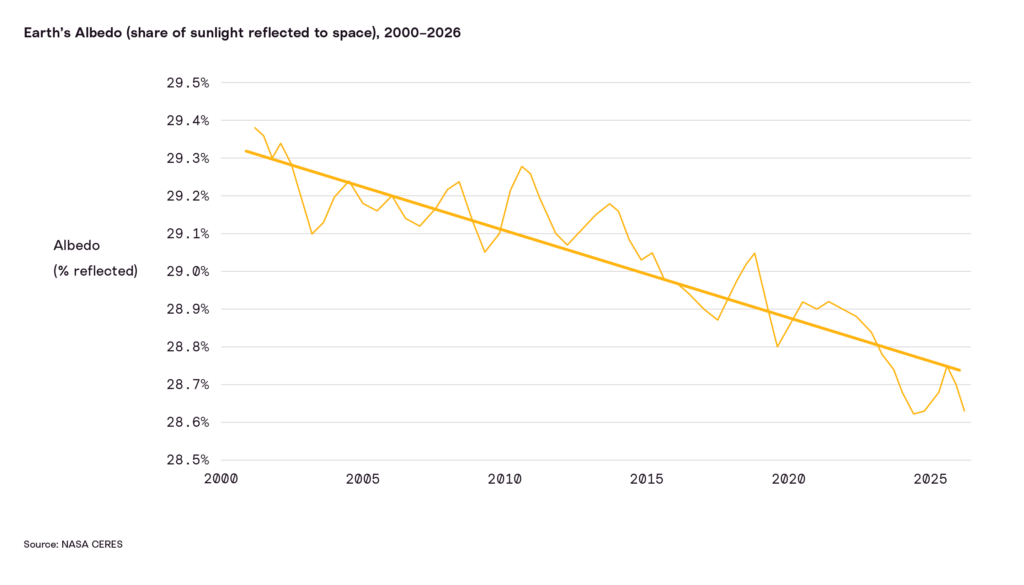
As Earth's albedo declines, the climate retains more heat. If this trend continues, the albedo-climate feedback loop will amplify, and we will lose more control over the planet’s warming. What happens next with Earth’s albedo depends on how quickly we curb warming.
Stopping or reversing albedo loss
Fully stopping albedo loss would require stopping global warming. Protecting high-albedo landscapes, restoring ecosystems, and reducing pollution that darkens snow and clouds can help slow the decline in albedo, but none of these approaches can counteract the additional heat captured by rising greenhouse gas levels in the atmosphere. The most effective action is to cut emissions.
It may eventually be possible to artificially increase Earth’s reflectivity by sending more sunlight back into space. This could cool the planet by reducing the amount of solar energy Earth absorbs, even though it wouldn’t remove greenhouse gases from the atmosphere.
Some proposed approaches to managing albedo loss are better understood than others, and some carry greater risks or uncertainties. Potential methods include:
Surface albedo modification approaches:
- Cool roofs. Bright roofing designed to reflect sunlight.
- Cool pavements. Light-colored or coated surfaces that bounce light away.
- Marine and polar brightening. Techniques to make ice brighter so it reflects more sunlight.
Stratospheric and atmospheric modification approaches:
- Stratospheric aerosol injection. Mimics the cooling effect of large volcanic eruptions by releasing reflective particles, such as sulfur dioxide, into the stratosphere to scatter sunlight before it reaches Earth's surface.
- Marine cloud brightening. Adds tiny sea salt particles or other natural aerosols to low-level marine clouds, making them whiter and more reflective.
While there is uncertainty around these specific technologies and strategies, it does appear that intervening in the albedo-climate feedback loop would be necessary to manage future warming. Without managing feedback loops in the climate, it is possible that Earth continues to warm, even after humans stop emitting greenhouse gases.
Was this article helpful?
Thank you. Your feedback helps us improve.