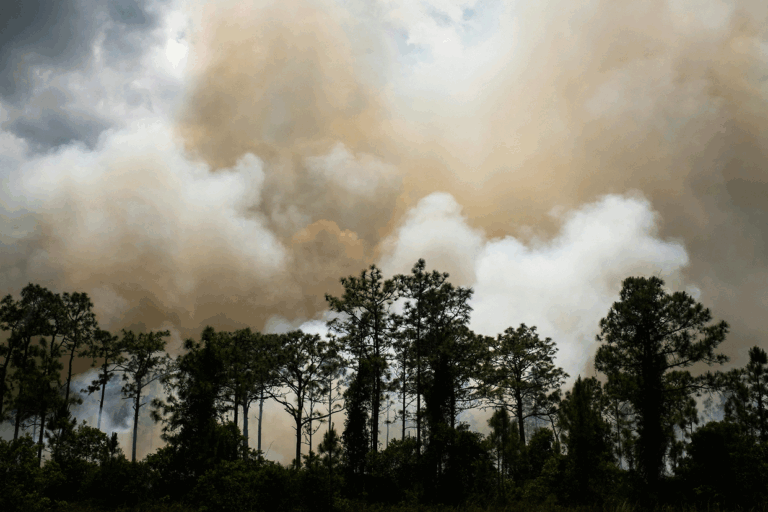
Mirey Atallah, Chief of the Adaptation and Resilience Branch, Climate Change Division, United Nations Environment Programme and Abid Hussainy, Senior Specialist Environment, Climate Change, and Water, The Urban Unit, Government of Punjab, Pakistan spoke to Probable Futures about 50°C temperatures, heat risk and adaptation in Lahore, Pakistan, and why adapting to the future of urban heat is crucial as our planet warms.
Temperatures above 50°C (122°F) can be incredibly risky for human beings. In any heat higher than body temperature, our bodies have to work to cool us down. The hotter it becomes, the harder that work is on the body. Especially when combined with high humidity levels and underlying health conditions, heat can accelerate risks of exhaustion and organ failure.
Above 50°C it can be unsafe for humans to stay outside more than a few minutes, and asphalt temperatures can rise to 60 to 70°C (140 to 158°F). High heat is even riskier for humans when combined with the urban heat island effect, a phenomenon in which built-up urban areas are hotter than surrounding rural ones. Other social factors, like limited access to cooling and healthcare or needing work outside, can contribute to unequal distribution of risk across a community.
“We’re seeing greater instances of dangerous heat in urban environments around the world, both in terms of how high temperatures get and how long heat stays in place. Climate impacts are no longer future and hypothetical; they are being lived now.”—Mirey Atallah
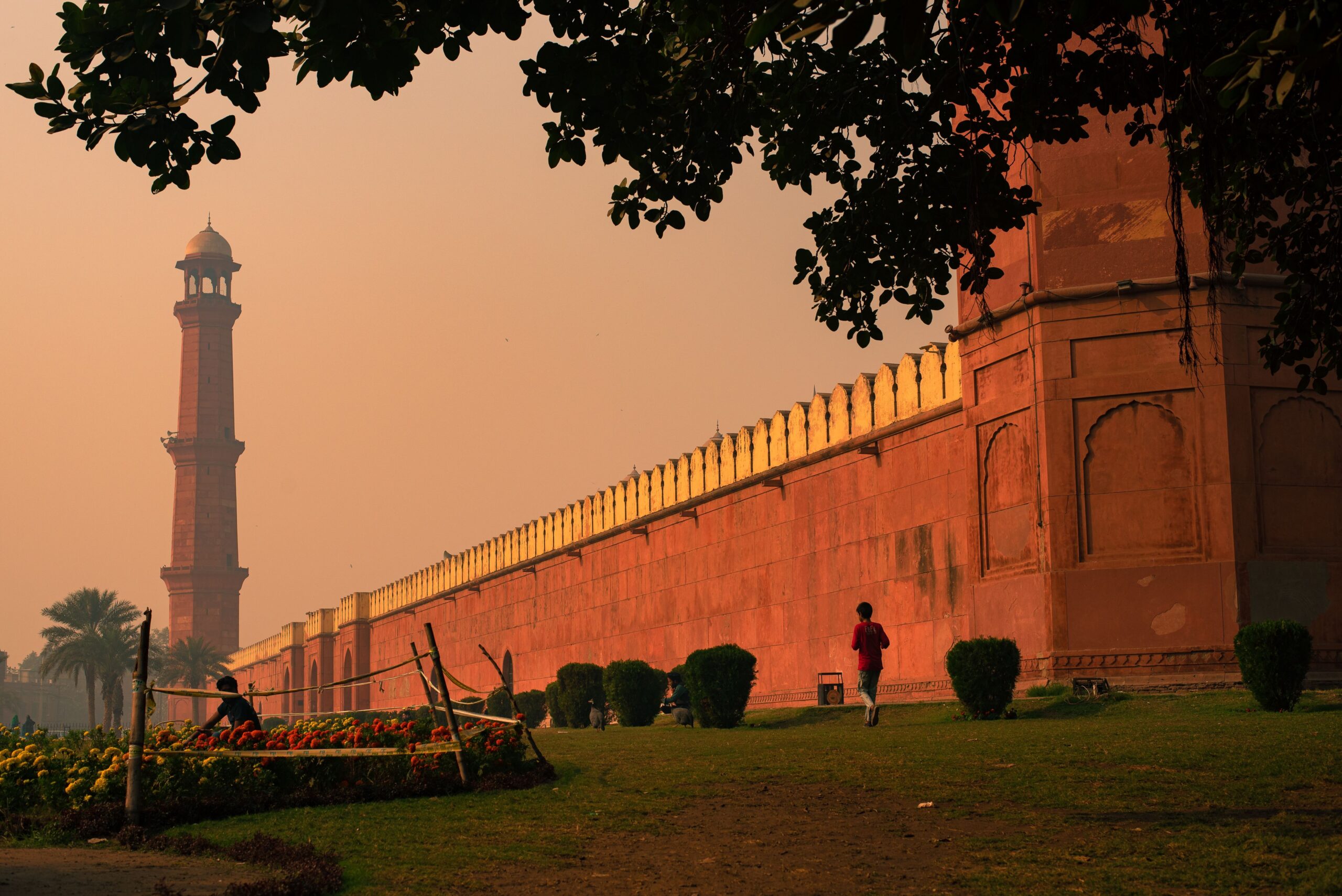
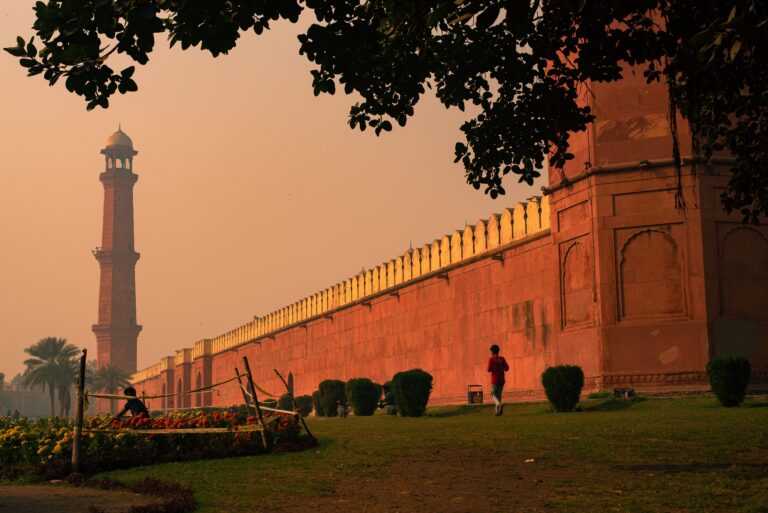
In Lahore, Pakistan—the capital and largest city in the province of Punjab—deadly heat risk is increasing for the population of 13 million, and recent heat waves have approached 50°C. In 2022, Lahore experienced its greatest heat wave on record, with reported temperatures from April 20 to May 20 reaching 49°C. The rapid growth of the city combined with increasing air pollution has made extreme heat more intense for residents.
“Over the past decade, extreme heat has become a much more visible and persistent part of Lahore’s summers. We are seeing longer periods of intense heat, while rapid urban expansion, coupled with the loss of green spaces, is making it harder for the city to cool down.”—Abid Hussainy
Historically, temperatures this high were anomalous in Lahore. But as our climate changes, heat waves and unusually high temperatures are becoming more frequent, prolonged, and intense. Examining the Probable Futures map of days above 50°C in Lahore shows how higher warming levels could impact the number of extremely hot days in a year.
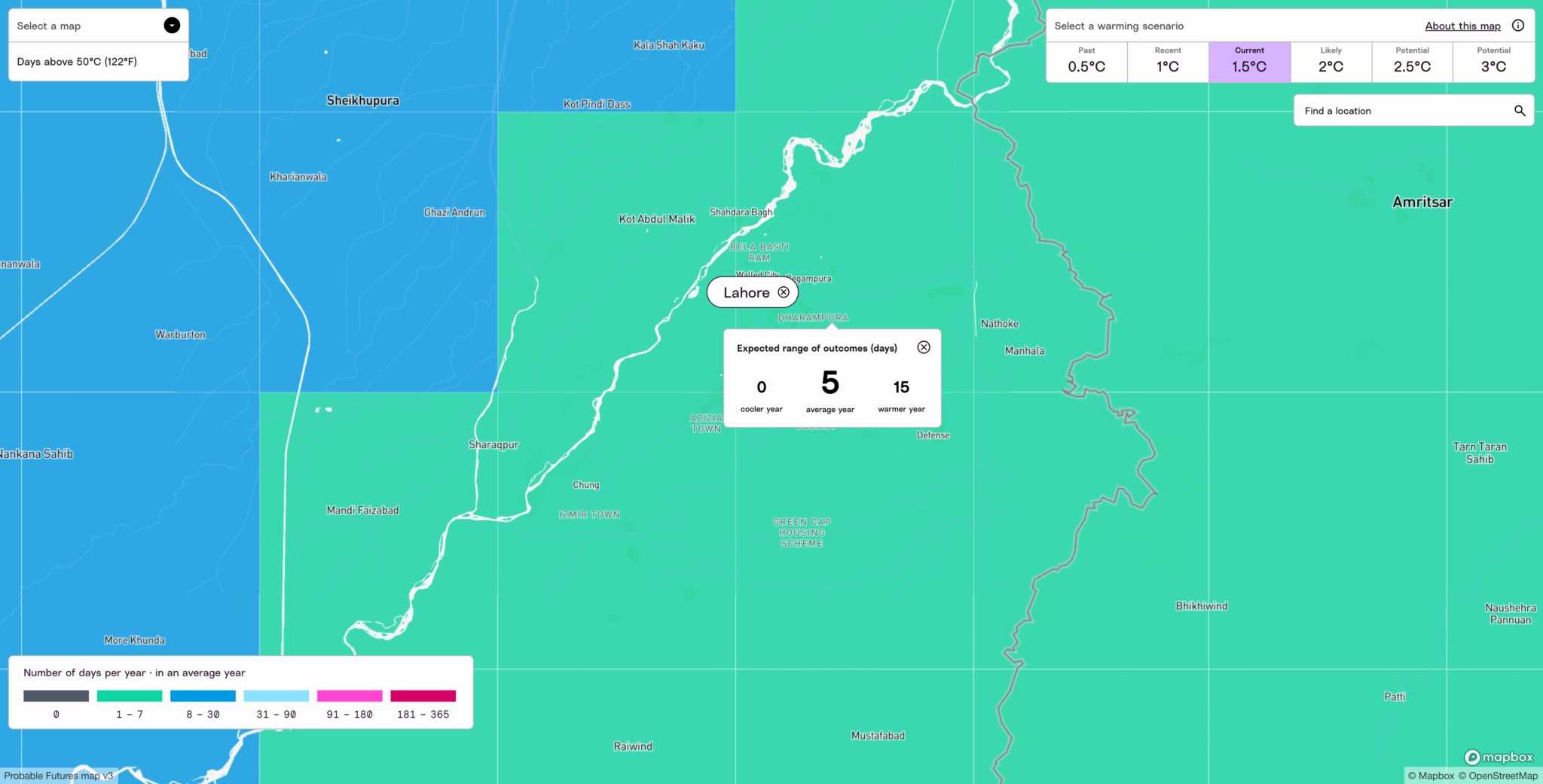
Use the search function in the map of days above 50°C (122°F) to zoom into Lahore, Pakistan at 1.5°C of warming.
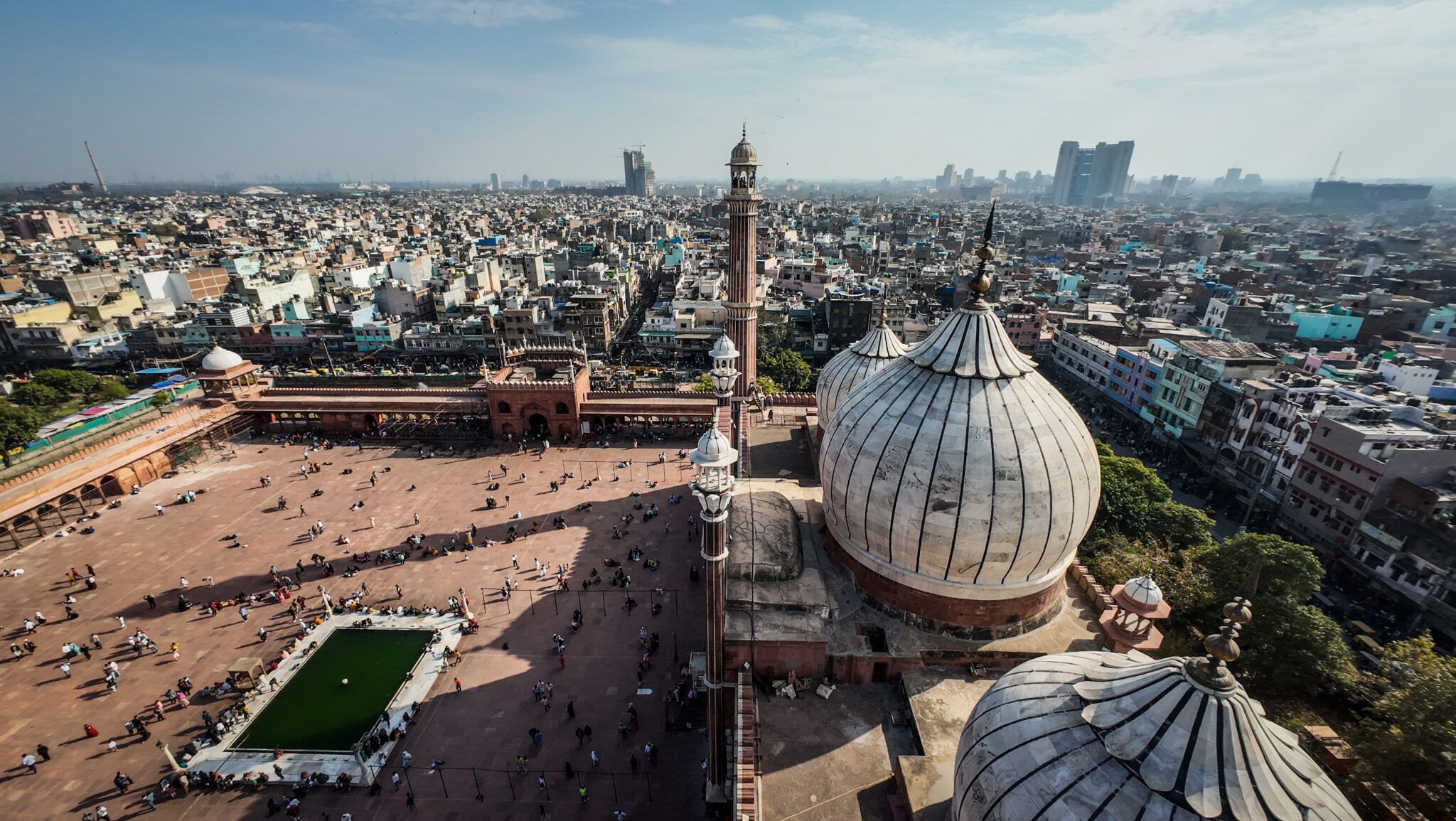
The urban heat island effect in Lahore
Climate zone: hot, semi-arid
Population: 13 million
Risk factors: heat, flooding
Because of the urban heat island effect, cities face even hotter temperatures than their rural surroundings. In response to increasing urban heat risk, the United Nations Environment Programme (UNEP) launched 50@50, a collaborative effort with more than 50 cities across the world to avoid and adapt to intensifying heat, featuring the Probable Futures map of days above 50°C (122°F).
“The 50@50 activation aims to strengthen urban heat preparedness by providing data, stress-testing systems, and facilitating peer-to-peer learning about practical solutions. Maps like these help to make impacts of extreme heat vivid and inform adaptation planning.”—Mirey Atallah
Lahore is one of the participating cities in 50@50 and, according to local experts and climate projections, is likely to face compounding heat risk as the climate warms. Over the last 25 years, Lahore has experienced rapid expansion, with its population doubling and the city increasing in area by nearly threefold.
More human activity, like driving cars and operating factories, as well as a greater area of paved surfaces, adds and traps heat in the local environment. A 2026 study attributed an average 4.1°C difference in temperature between Lahore and the surrounding area to the urban heat island effect, meaning within the city of Lahore future temperatures could be even higher than anticipated.
“The near future of urban heat could be much more extreme than many residents anticipate or are prepared for.”—Mirey Atallah
Lahore in a historic climate
Over the course of at least two thousand years of humans living in the region of Lahore, Pakistan, the local climate remained relatively stable. Residents of Lahore could expect damp, cool winters, pleasant springs, two months of summer heat before the monsoon, and dry autumns. Although summers were hot, temperatures were predictable, with the warmest month of June seeing temperatures between 28°C (83°F) and 39°C (102°F), on average.
In 1944, Lahore officials noted a record high temperature of 48°C (119°F), hotter than any day previously measured. In 2007, temperatures reached the same record. Still, there were no recorded days above 50°C (122°F).
Lahore at 1.5°C of warming and beyond
According to Berkeley Earth, around 2024, Earth’s global average surface temperature reached 1.5°C above the pre-industrial average for the first time. Because degrees of warming are average measures of Earth’s complex climate using data from the recent past, scientists cannot pinpoint a precise moment when we pass the 1.5°C threshold. In Probable Futures maps, 1.5°C is labeled as “current,” reflecting the scientific consensus that we will almost certainly exceed this warming level and that individual recent years have averaged above this temperature, while further warming levels are still preventable.
This map of Lahore depicts days above 50°C (122°F) at 1.5°C of warming. At 1.5°C of warming, this grid cell in Lahore has 5 days above 50°C in an average year and 15 in a warm year.
An average year at 1.5°C of warming is projected to have five days above 50°C (122°F), while an exceptionally warm year (because of natural fluctuations in Earth’s climate) could have as many as 15 days above 50°C (122°F). Scientists anticipate a record-breaking El Niño phase, one of the naturally occurring changes in the global climate that could raise annual temperatures, in 2026-2027.
This gif shows how to access the range of outcomes in Lahore on the days above 50°C (122°F) map.
“The impact of extreme heat in Lahore now extends well beyond discomfort. It affects public health, increases demand for electricity and water, puts additional pressure on health facilities and other essential urban services, and changes when and how people can safely work, travel, and carry out daily activities.”—Abid Hussainy
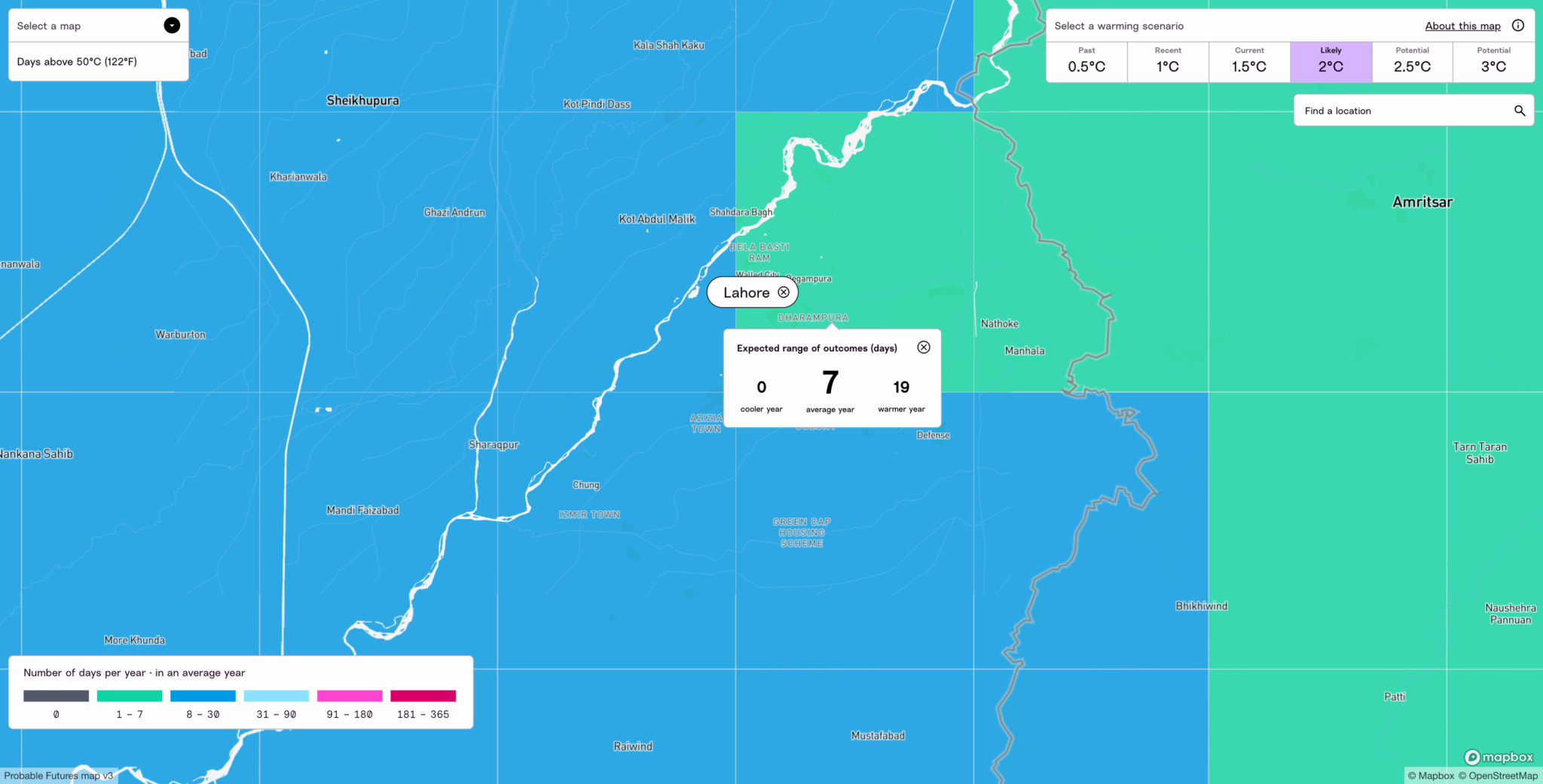
This map of Lahore depicts days above 50°C (122°F) at 2°C of warming. At 2°C of warming, this grid cell in Lahore has 7 days above 50°C in an average year and 19 in a warm year.
At 2°C of warming in Lahore, an average year might have seven days above 50°C (122°F) and a warm year as many as 19. Reaching 2°C is likely, given our current warming and emissions trajectories, but theoretically avoidable with immediate and severe emissions reductions.
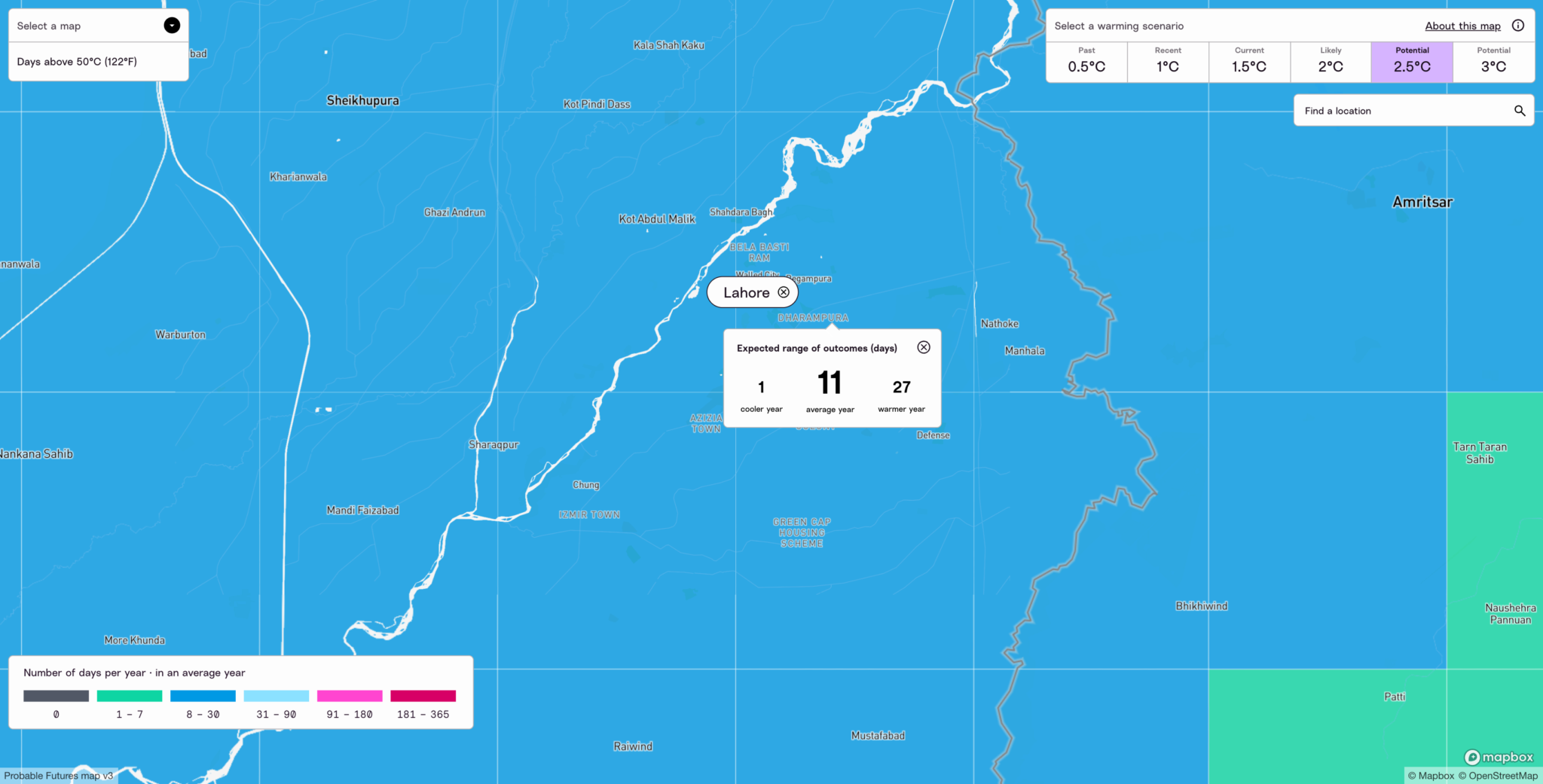
This map of Lahore depicts days above 50°C (122°F) at 2.5°C of warming. At 2.5°C of warming, this grid cell in Lahore has 11 days above 50°C in an average year and 27 in a warm year.
“For Lahore, the question is no longer whether extreme heat will become a major urban challenge, but how quickly and effectively we can prepare for it.”—Abid Hussainy
2.5°C and 3°C of warming are potential but avoidable, depending on the pace and scale of human greenhouse gas emissions. At 2.5°C of warming, an average year might experience 11 days above 50°C (122°F) and a warm year as many as 27 (nearly a month).
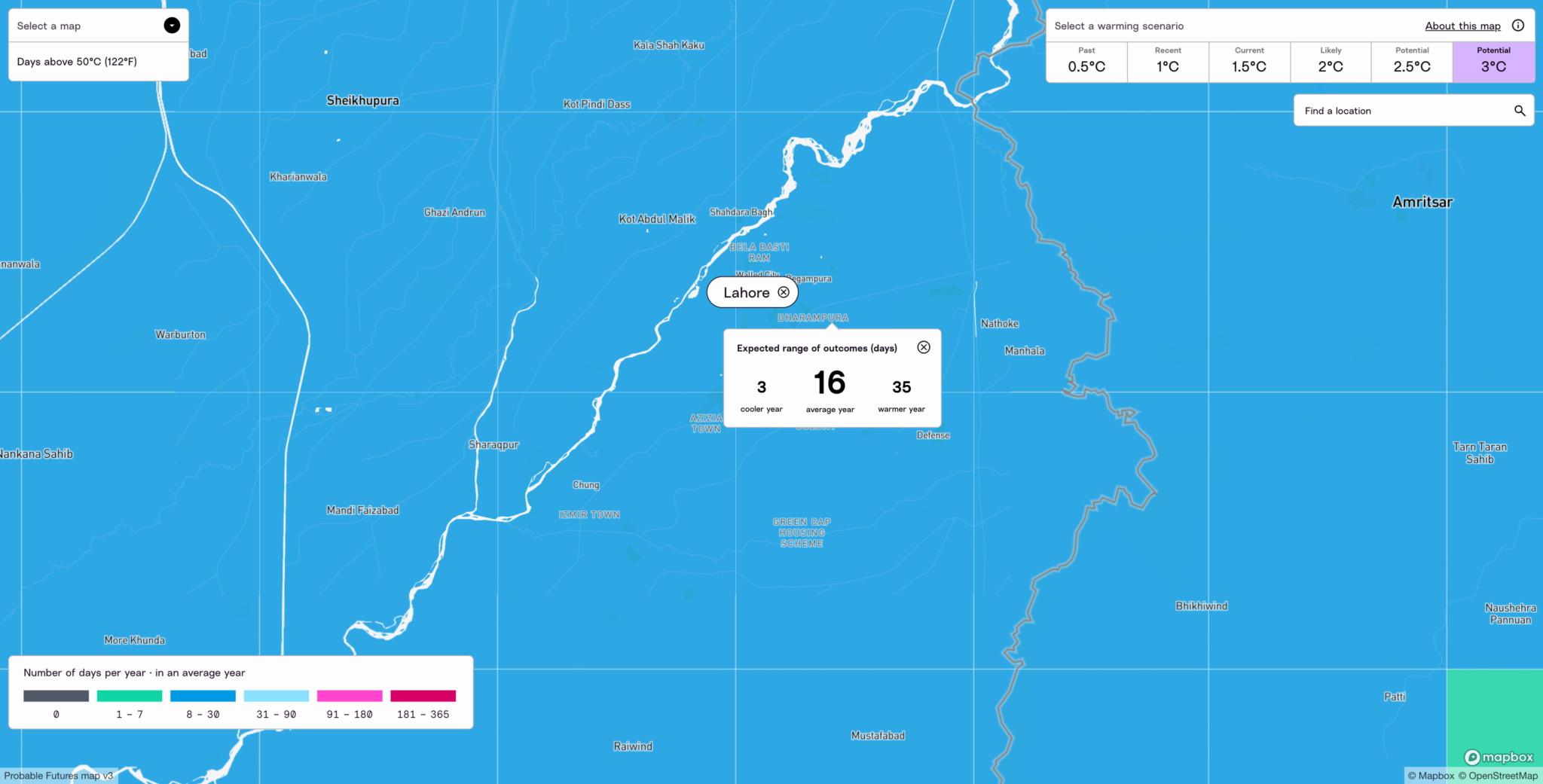
This map of Lahore depicts days above 50°C (122°F) at 3°C of warming. At 3°C of warming, this grid cell in Lahore has 16 days above 50°C in an average year and 35 in a warm year.
At a potential 3°C of warming in Lahore, an average year might experience more than two weeks of days above 50°C (122°F) in an average year, and, in a warm year, more than a month’s worth of days.
If the planet reaches 3°C, there is a question of whether or not humans can adapt to these temperatures. It may not be possible for cities to limit the exposure and vulnerability of residents and infrastructure to over 30 days above 50°C. If we rapidly reduce greenhouse gas emissions and sustain those reductions, it is possible to avoid 3°C of warming.
“It is possible to prevent much of the heat outcomes, whether in terms of occurrence, duration, intensity or impacts”—Mirey Atallah
What could days above 50°C mean for Lahore?
To manage rising heat risk and address the urban heat island effect, Lahore is planning and implementing climate adaptation strategies. City officials are redesigning spaces to retain less heat by expanding tree cover and greenery, which reduces local temperatures and improves air quality. The city has also implemented a Heat Alert System, which provides early warnings before heat events occur, allowing authorities and communities to prepare in advance and manage their heat exposure.
Adaptive strategies like these, informed by data showing cooler, average, and hotter possible outcomes, can help cities and residents prepare for the future of urban heat risk. “High temperatures alone do not determine risk. The greatest impacts occur where intense heat intersects with high exposure and social vulnerability. The larger challenge for Lahore is not simply managing higher temperatures, but addressing unequal capacity to cope with them. A household with reliable electricity, cooling, safe drinking water, and access to healthcare experiences a heatwave very differently from a family without these protections,” says Mr. Hussainy.
“Lahore’s approach to extreme heat is evolving from emergency response towards long-term, risk-informed resilience.”—Abid Hussainy
Here are a a few guiding questions to consider about adapting to days above 50°C in Lahore:
Managing heat risk involves limiting exposure and vulnerability to dangerously high temperatures. How can government officials anticipate who is most vulnerable to heat due to age, health, or social factors and increase their resilience before extreme heat events occur?
Days above 50°C can carry health risks for humans outside. How can the city of Lahore adjust outdoor labor protections to ensure workers stay safe during the hottest times of day? What about those who are inside without cooling or drinking water?
Rapid urban expansion plays an important role in Lahore’s heat risk. How can government officials intervene in urban planning to ensure new development doesn’t worsen heat conditions for residents?
“At the Urban Unit, we assess climate risks and vulnerabilities, integrate gender and social considerations, and help translate evidence into policies, action plans, and implementable projects such as the Lahore Climate Action Plan 2026.”—Abid Hussainy
Read more about how Lahore is adapting to heat in the Urban Unit’s Heatwave Management Plan of Lahore, a city-level initiative that examines climate risks and identifies pathways for resilience and action.
We use analytics to understand how people use our climate literacy resources in order to improve them. Learn more
Functional
Always active
The technical storage or access is strictly necessary for the legitimate purpose of enabling the use of a specific service explicitly requested by the subscriber or user, or for the sole purpose of carrying out the transmission of a communication over an electronic communications network.
Preferences
The technical storage or access is necessary for the legitimate purpose of storing preferences that are not requested by the subscriber or user.
Statistics
The technical storage or access that is used exclusively for statistical purposes.The technical storage or access that is used exclusively for anonymous statistical purposes. Without a subpoena, voluntary compliance on the part of your Internet Service Provider, or additional records from a third party, information stored or retrieved for this purpose alone cannot usually be used to identify you.
Marketing
The technical storage or access is required to create user profiles to send advertising, or to track the user on a website or across several websites for similar marketing purposes.